




Ripple
October 27, 2026
XRP Price Sits at $1.30 as Ripple Wins Final US Trust Bank Approval and Whale Holdings Rise
The XRP supercycle prediction from analyst Amonyx points to $45.50, but XRP trades near $1.34, below the $1.50 to $2.10 support zone his chart rests on. The token slid further after Binance disclosed a security incident with an estimated $6.3 billion impact and paused withdrawals, which shook the whole crypto market. As TradingView reveals, the XRP Ledger bug fix slipped to November 4 instead, after validator backing fell from the required 29 of 35 to 26 and reset the 14-day approval window.
Support later recovered to 31 validators. Right now, the XRP 2026 supercycle call, talk of next bull run and XRP exchange reserves at a one-year high all point to the same few weeks.
Also Read: XRP Eyes $5 First, but ETF Outflows Challenge the $15 Bull Run
Binance, the largest crypto exchange by trading volume, paused deposits and withdrawals after attackers pulled funds from one of its hot wallets on October 29. The exchange put the estimated impact at about $6.3 billion, which would make it the largest crypto theft on record, more than four times the $1.5 billion lost in the 2025 Bybit attack. Binance said it froze roughly $3 billion on-chain with help from blockchain partners and pledged to cover losses through its SAFU fund and company resources.
Binance stated on X:
“Binance’s initial investigation suggests that the security incident may involve a compromised DevOps engineer’s laptop, which allowed an attacker to gain access to a service container and submit unauthorized withdrawal transactions.”
The exchange added that it found no evidence of a leaked wallet private key. Co-founder Changpeng Zhao, who no longer runs the company, also weighed in on X:
“User funds are safe! It does look like a hack on Binance.”
Zhao thanked Tether and Circle for freezing about $971 million in USDT and $823 million in USDC tied to the attack. Still, roughly $3.3 billion sits outside Binance’s control, and the final loss figure could shift as the investigation continues.
The news hit the whole market, and XRP took a sharp share of the pain. XRP sits at $1.25, down 5.5% over seven days, with a 24-hour range between $1.20 and $1.31. That puts the token about 7% below the $1.34 level it held when the XRP Ledger bug fix first slipped to November.
The timing matters for the XRP supercycle prediction. Binance runs one of the biggest XRP order books, and a freeze on withdrawals leaves part of those XRP exchange reserves stuck in place until services resume. Binance said it expects withdrawals to restart once it rebuilds the affected service and addresses.
Per Invezz, XRP broke below the $1.24 support during the sell-off, which leaves $1.16 as the next floor. A clean break there could bring $1.04 into view, with $0.98 further down. On the upside, the 20, 50 and 100-day EMAs cluster between $1.33 and $1.35, so any XRP next bull run attempt first has to clear that band. The daily RSI sits near 38, weak but not yet oversold.
The XRP Ledger bug fix, fixCleanup3_4_0, targets a token-minting loophole and other calculation issues. A short dip below 80% support wipes the 14-day clock.
The official XRPL documentation stated:
“Until the fixCleanup3_4_0 amendment is enabled, it is recommended not to delegate the PaymentBurn granular permission.”
In plain terms, accounts should not hand that permission to anyone else until the XRP Ledger bug fix goes live, so the delay affects everyday users, not only traders. The market read it as bad news too. TradingView had put the odds of XRP touching $4.00 in October at just 0.3%, a blow to the XRP supercycle prediction that the Binance sell-off has only deepened.
The XRPL release notes for version 3.4.0 stated:
“If you run an XRP Ledger server, upgrade to version 3.4.0 as soon as possible to ensure service continuity.”
That release ships the XRP Ledger bug fix, now back on the clock. A clean activation removes one worry from the XRP next bull run case and the wider XRP supercycle prediction.
As TechBullion reveals, XRP held on exchange addresses hit 11.81 billion tokens on October 17. Binance derivatives open interest fell 15.8% as XRP slid from roughly $1.52 toward $1.29, a leverage flush.
High XRP exchange reserves don’t prove selling, since many wallets belong to custodians. That same exchange now faces a $6.3 billion hack on top of MiCA scrutiny in Europe, and US traders get 10x leverage on crypto perpetuals at a major broker, so leverage can return and test any XRP supercycle prediction.
An XRP supercycle in 2026 needs spot demand to soak up those exchange reserves. That is the plain math behind every XRP supercycle prediction right now.
Also Read: XRP and Dogecoin MVRV Signals Point to Opportunity as XRP Price Targets $2
Amonyx’s chart maps a decade-long XRP structure from 2014 to a projected 2028. It shows an ascending triangle topped at $2.10.
A late 2024 rally above $3 flipped $2.10 into support, leaving $1.50 to $2.10 as the launchpad. At $1.25, XRP trades under that band, so the XRP next bull run setup first needs a move back above $1.50.
CoinCodex now projects XRP trading between $1.18 and $1.38 for the rest of 2026, averaging $1.29 for a potential 10.37% return. A week ago, before the Binance sell-off, that yearly ceiling sat at $1.56. November carries the stronger range, $1.20 to $1.38, while December slips to $1.18 to $1.34. Even $1.38 sits far below $45.50, showing how stretched the XRP supercycle prediction looks.
Per CoinCodex, XRP averages a 132.55% gain in Q4 and 15.79% in Q1. Even more, Q4 closed red in seven of 13 years, including a 35.43% drop in 2025, a mixed record for an XRP next bull run.
XRP’s full-year record swings even harder. A 35,162.28% gain in 2017 took the token from $0.006449 to $2.27. Then 2018 wiped out 84.49% and sent it back to $0.3528. That pairing shows how fast an XRP supercycle story can flip.
2026 has followed its own rough script so far. XRP lost 27.24% in Q1 and 22.52% in Q2, then rebounded 43.47% in Q3, but Q4 has erased much of that bounce. Even before the Binance sell-off, at $1.29, CryptoTicker put XRP 28.8% below where it started the year. Across 13 complete years, XRP closed seven in the green and six in the red. Its 2,758.45% average yearly growth leans almost entirely on 2017. Therefore, seasonality alone won’t carry the XRP supercycle prediction.
Also Read: XRP Price Sits at $1.30 as Ripple Wins Final US Trust Bank Approval and Whale Holdings Rise
Shorter timeframes paint a mixed picture for the XRP supercycle prediction. XRP lost 5.42% over seven days and 2.88% in the past 24 hours as the Binance hack hit the wider market, though it still holds a 17.96% gain over three months. That three-month figure comes almost entirely from the strong Q3 rebound, and it shrinks a little more with every red day in Q4.
XRP lost 16.32% against the dollar in the past month and 10.83% against Bitcoin, while it held flat against Ethereum with a 0.12% gain. A week ago, the same table showed a 2.16% weekly gain and a 12.28% monthly loss, so the Binance sell-off turned a modest bounce into a clear slide within days.
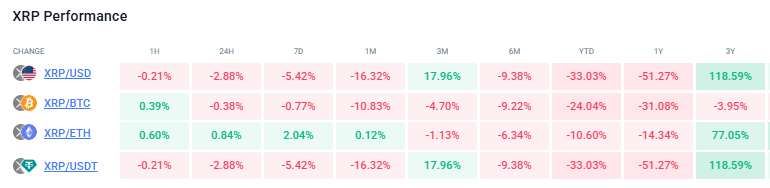
The token’s pairs tell a more nuanced story than its dollar price. Against Ethereum, XRP rose 2.04% over seven days and 0.84% in the past 24 hours, which means ETH fell even harder during the sell-off. Against Bitcoin, XRP slipped only 0.77% over the week, a sign that the latest drop hit the whole market rather than XRP alone.
That matters for the XRP next bull run case. A token that drops in step with Bitcoin can recover in step with it, while a token that bleeds against BTC needs its own catalyst. Right now, XRP sits closer to the first group on a weekly view, but the monthly 10.83% loss against Bitcoin shows it has trailed the market leader since early October.
Zoom out, and the XRP supercycle prediction faces a steeper climb. XRP trades 33.03% lower since January and 51.27% lower than a year ago, and it is down 9.38% over six months. Against Bitcoin, it has lost 24.04% year to date and 31.08% over twelve months.
The three-year view offers the only bright spot. XRP is up 118.59% against the dollar over that span and 77.05% against Ethereum, while it has stayed roughly even with Bitcoin, down just 3.95%. In other words, XRP kept pace with BTC across the last cycle but gave back much of its edge in 2026. With XRP exchange reserves still near a one-year high, the XRP next bull run would start from a deeper hole than a week ago, and any XRP supercycle 2026 call has to win back that lost ground first.
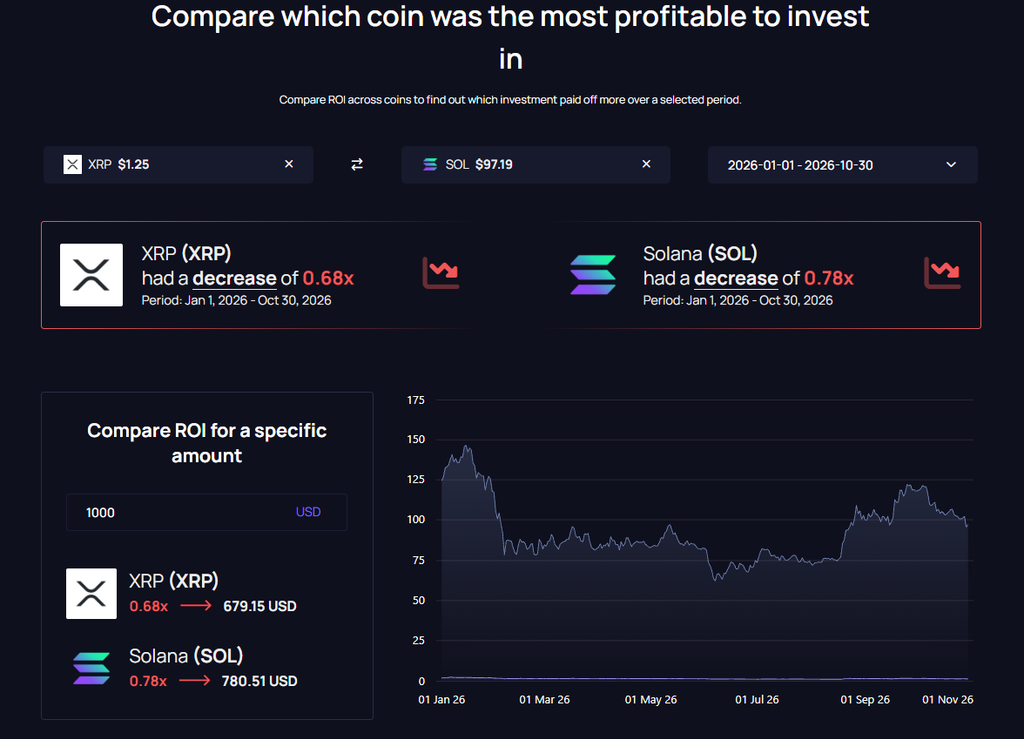
A year-to-date check puts that slide next to Solana on MarketCapOf’s ROI calculator. From January 1 to October 30, XRP returned 0.68x, turning $1,000 into $679.15, while SOL returned 0.78x, leaving $780.51. That $101 gap, with XRP exchange reserves still high, means the XRP next bull run would start from a deeper hole, and any XRP supercycle prediction has to account for it.
Neither token escaped the Binance sell-off. A week earlier, the same $1,000 stood at $728.05 in XRP and $838.17 in SOL, so XRP lost about $49 and SOL about $58 in just eight days. Solana fell slightly harder in dollar terms, which narrowed the gap from $110 to $101. Still, SOL trades near $97.19 and keeps its lead for the year, while XRP sits at $1.25 and needs a stronger rebound just to catch up.
The week before the hack, Bitcoin drew support as spot ETFs posted $241M in weekly inflows, and surveys show wealthy investors and institutions planning bigger crypto allocations. TRON is averaging 4.41M daily active accounts, so the XRP supercycle in 2026 case faces real competition.
November 4 is the near-term test. The XRP Ledger bug fix needs to keep at least 29 of 35 validator votes until activation, projected for about 14:46 UTC that day. It held 31 at the last public count on October 22, so two validators could drop off without resetting the clock, with just five days left on the countdown. One more slip would push the date back another two weeks and leave the XRP Ledger bug fix question open into late November.
The last reset shows how thin that margin can be. Support fell to 26 validators at 12:54 UTC on October 21 and recovered about two hours later, yet that short gap was enough to wipe almost two weeks of progress. The network checks votes every 15 minutes, so even a brief outage at a single validator can count against the amendment.
What Node Operators Need To Do Before Activation
Servers that still run older software face a hard deadline. Node and validator operators who have not moved to version 3.4.0 or later will become amendment-blocked once fixCleanup3_4_0 goes live, which means their servers stop following the ledger. That gives operators a clear reason to upgrade now rather than after November 4.
For traders, a smooth switch would remove one technical overhang from the XRP supercycle prediction. A messy one, with blocked servers or another vote reset, would add fresh doubt at a time when the market already deals with the Binance fallout.
The fix also clears the way for the network’s bigger lending upgrade, which still lacks the votes to start its own countdown. Recent validator data cited by Coinpaper showed LendingProtocol and LendingProtocolV1_1 with 19 votes each and SingleAssetVault with 21, all short of the 29 needed. Native lending would give the XRP Ledger a new source of on-chain demand, a piece many bulls count on for an XRP next bull run.
TradingView’s report adds a second test outside the ledger: any regulatory clarity from the U.S. SEC could shift how traders price XRP’s next targets.
Also Read: OCC Finalizes GENIUS Act Rules as Crypto Firms Seek SEC Clarity & Trump Plans Scam Crackdown Remarks
On the price side, XRP first needs to reclaim $1.24, the support it lost during the Binance sell-off. A daily close back above that level could open a run toward the EMA cluster between $1.33 and $1.35, with further resistance at $1.37, $1.48 and $1.66. Only after those hurdles does $1.50 turn into a real test, and then $2.10, the old ceiling that Amonyx’s chart now treats as support.
Momentum gives buyers little help for now. The daily RSI sits near 38, and the Stochastic Oscillator reads around 30 and 29, weak but still above the oversold zone, which suggests selling pressure may not be exhausted yet. For the XRP supercycle 2026 call, CoinCodex’s range for the rest of the year tops out at $1.38, far short of the chart’s $45.50 target.
On the downside, a break below $1.16 could bring $1.04 into focus, followed by a deeper floor near $0.98, per Invezz. XRP exchange reserves add to that risk, since 11.81 billion tokens sitting on trading venues give sellers an easy exit on every bounce. If Binance reopens withdrawals and part of those coins move off the exchange, the pressure would ease. If they stay put, every rally runs into supply.
Right now, the XRP supercycle prediction stays a long-range bet. A clean November 4 activation, a calmer market once Binance reopens withdrawals, falling reserves and a reclaim of $1.50 would give the XRP next bull run a real base to start from. A miss on any of them keeps the forecast on paper.

Written by Vladimir Popescu
Vladimir Popescu leads editorial coverage at MarketCapOf, with over 8 years in financial and tech journalism. He previously held editorial leadership roles at Watcher Guru and Windows Report, and has been cited by Forbes for his crypto market coverage.