




Business
October 23, 2026
Ethereum Upgrade Hits Roadblock as BTC and ETH Plunge and $210M in Longs Get Wiped Out
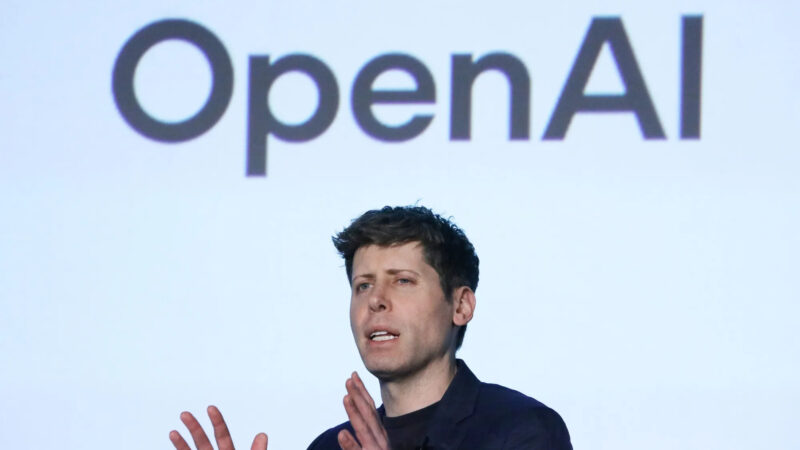
The AI domain is experiencing significant developments as of late, progressing rapidly on a global scale. The arena has now become one of the most competitive domains to explore, as new hints of OpenAI reportedly nearing a funding round of up to $30B have started to gain momentum. Reports further add how the $30B funding round may end up helping the firm hit a $1.25T pre-money valuation as it prepares for a potential Open AI IPO. At the same time, the US Treasury is working its way to introduce new US AI rules. Under the new proposed document, the US Treasury has proposed restrictions on America’s foreign investments in AI, suggesting a ban on making AI investments in certain countries.
Also Read: Meta Class C Shares Give Zuckerberg Fresh Funding Without Losing Control
Per the latest CNBC report, OpenAI is reportedly in talks to raise $30B at a $1.25T pre-money valuation. Investors from the UAE and the investment firm Coatue are leading the round, according to reports, although the final amount and terms have not been confirmed. The proposed amount is lower than the earlier $1.4T figure that was discussed in earlier fundraising discussions.
The revised target could help support rising AI infrastructure costs, develop models, and meet the growing demand for OpenAI products. The funding round could provide additional capital ahead of a potential Open AI IPO. Although the company has not confirmed a listing date.
Also Read: XRP Price Eyes $1.52 as $48M Whale Bet Defies Bearish Traders
In the middle of the rising AI narrative, the Treasury Department has proposed a new set of US AI investment rules. The proposed rules would restrict certain US investments in countries of concern for national security reasons. The proposal covers sectors such as artificial intelligence, semiconductors, supercomputing, and biotechnology.
The proposed measures aim to restrict certain US investments in countries such as China, Russia, Iran, North Korea, and Cuba. The Treasury has built a framework to prevent American capital from supporting the development of technologies that could strengthen the military capabilities of these countries. However, the suggested rules are still at the proposal stage and are yet to be finalized.
The AI domain has now become a central arena for countries to take the lead in. With major AI companies like Anthropic and Open AI exploring an IPO, it shows how AI infrastructure and its role in society are evolving dynamically with a futuristic vision. At the same time, the US measures regarding foreign investments in AI reflect national security concerns about capital and technology potentially supporting strategic competitors. These developments show how AI investment is becoming increasingly tied to both economic competition and national security. Moreover it shows how competitive the domain is becoming with time.
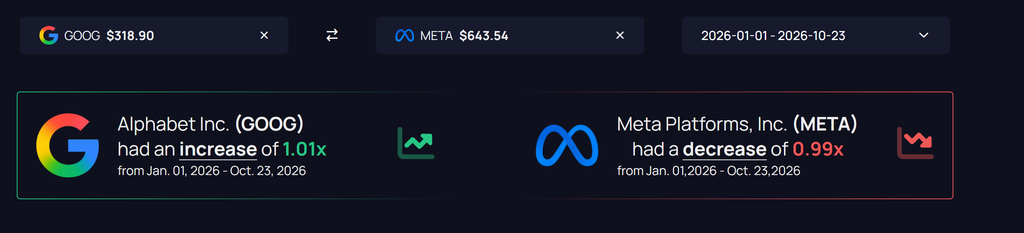
To put this into perspective, according to the MarketCapOf ROI Calculator, Alphabet (Google) has gained around 1% in 2026 so far, while Meta has declined by roughly 1% through October 23, according to the comparison. The performance highlights how the market narrative around major tech companies can shift, even more so once OpenAI and Anthropic enter the arena to compete for investor attention. The potential IPOs of OpenAI and Anthropic could further reshape sentiment toward the AI sector, depending on their valuations, growth prospects, infrastructure costs, and ability to turn AI demand into sustainable revenue.
Also Read: Bitcoin Still 34% Below ATH After 43% Rebound. What Factors Could Drive the Next BTC Rally?

Written by Juhi Mirza
Juhi Mirza is a crypto journalist and writer covering digital assets, blockchain, markets, and emerging trends in the Web3 industry.