



Business
October 21, 2026
Nvidia Expands Telecom AI Push as Firmus Funding Talks Emerge
Tesla’s latest earnings gave investors a welcome cash surprise, even as the cost of its expansion weighed on profit. Elon Musk used the update to outline plans for much higher vehicle production, with Optimus manufacturing also getting underway. Meanwhile, a possible SpaceX combination has added another question for Tesla stockholders. The results leave plenty to digest, particularly for investors trying to judge whether stronger cash generation can support the company’s growing list of commitments.
Also Read: Meta Stock Split Follows Earnings Beat as AI Spending Hits $145B
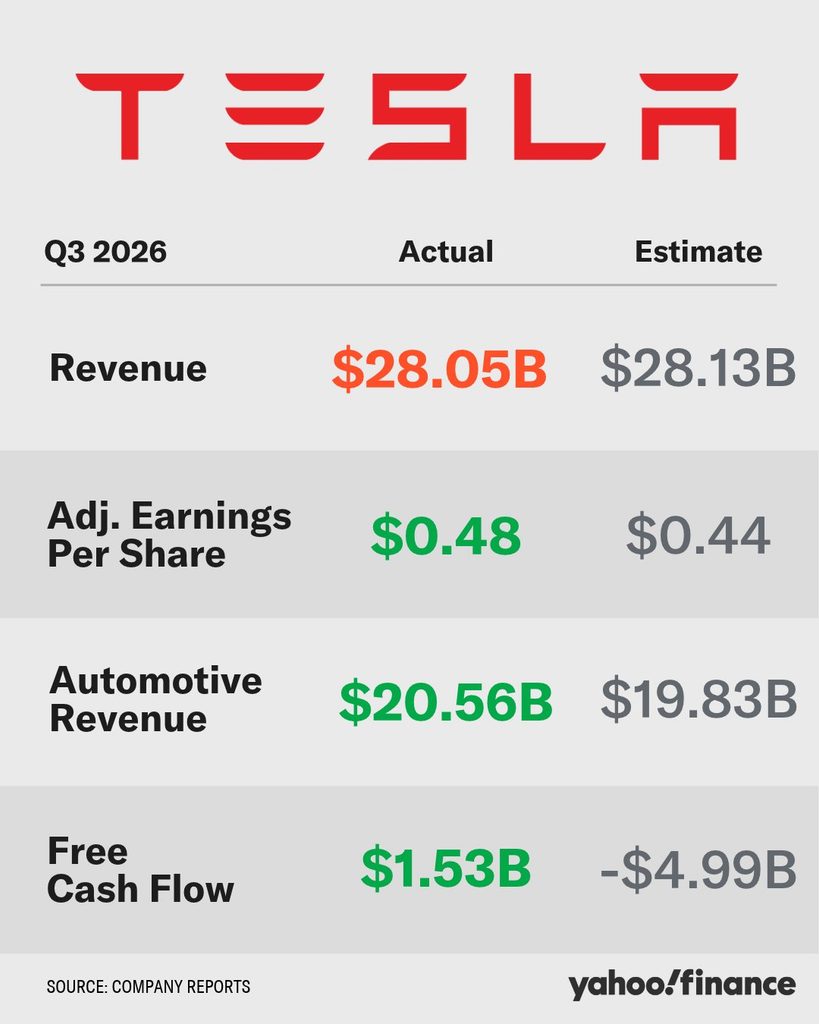
Tesla reported adjusted earnings of $0.48 per share, ahead of the $0.44 estimate. Revenue was essentially flat at $28.05 billion, slightly below that survey’s $28.13 billion estimate.
The stronger result came from cash generation. Free cash flow reached $1.53 billion after capital spending of $4.73 billion. But operating income dropped roughly 56% to $718 million as research spending increased and regulatory-credit revenue declined, according to Tesla’s quarterly update.
Musk’s ambitions remain large. He told investors Tesla aims to have the capacity to manufacture about five million vehicles annually around 2030. Tesla production target would require a substantial expansion, with demand and profitability determining how much of that capacity ultimately pays off.
Also Read: OCC Finalizes GENIUS Act Rules as Crypto Firms Seek SEC Clarity & Trump Plans Scam Crackdown Remarks
Tesla said its first production-quality Optimus robots had come off its Fremont lines. Manufacturing remains at an early stage, while the Texas robotics facility is under construction. The company has not disclosed commercial production volumes.
The potential Tesla-SpaceX merger is also unfinished business. Independent committees are examining a combination, and Musk has said his conflicting interests prevent him from joining their discussions. No transaction terms have been agreed.
MarketCapOf’s Tesla price chart records TSLA at $386.34 on October 21. Its separate October 1–22 return comparison puts TSLA’s gain at approximately 9.10%, ahead of SpaceX’s 6.92%. Those period returns should not be confused with the stock’s reaction to earnings.
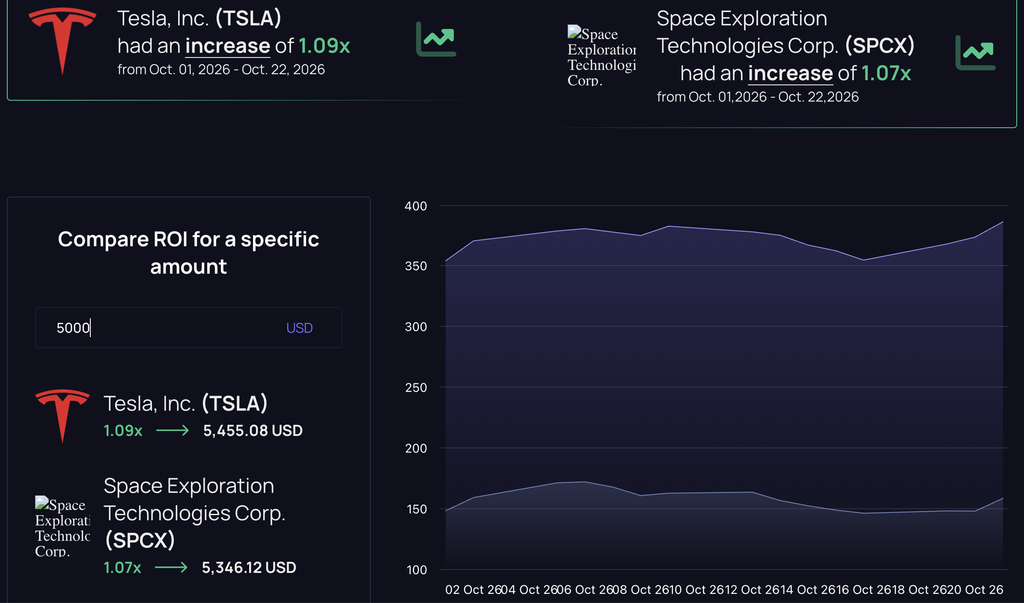
MarketCapOf’s comparison shows the recent difference in shareholder returns. A hypothetical $5,000 investment over October 1–22 would have grown to $5,455.08 in TSLA, versus $5,346.12 in SpaceX, leaving Tesla ahead by $108.96.
A merger would raise a different question of what shareholders receive in exchange for their holdings. Until terms emerge, investors have Tesla’s own results to assess, including whether its cash generation holds up as vehicle and robot production expands.
Also Read: Bitcoin ETFs Plunge 95.6% as Wintermute Moves $90M in BTC

Written by Sahana Kiran
Sahana Kiran has been covering financial markets since 2019, with a focus on cryptocurrencies, fintech, and the geopolitical events shaping them. She previously reported for AmbCrypto and Watcher Guru, and now writes for MarketCapOf.