






Business
November 5, 2026
US Stocks and 400-Ounce Gold Bars Move Toward Tokenization as Morgan Stanley and Hong Kong Expand Onchain Finance
About $40,000 in credit cards helped Kevin Plank get Under Armour off the ground, with inventory stored in his grandmother’s basement. Thirty years later, the Under Armour founder is trying to restore momentum at a business generating roughly $5 billion in annual revenue. Under Armour stock faces a harder question than whether its founder can build a brand. He already did that. Its November 6 earnings beat expectations, but the outlook suggests his comeback still has a long way to go.
Also Read: Nvidia Stock Crashes 9% Below $190: Can Apollo AI Talks and Q3 Earnings Spark a Recovery?
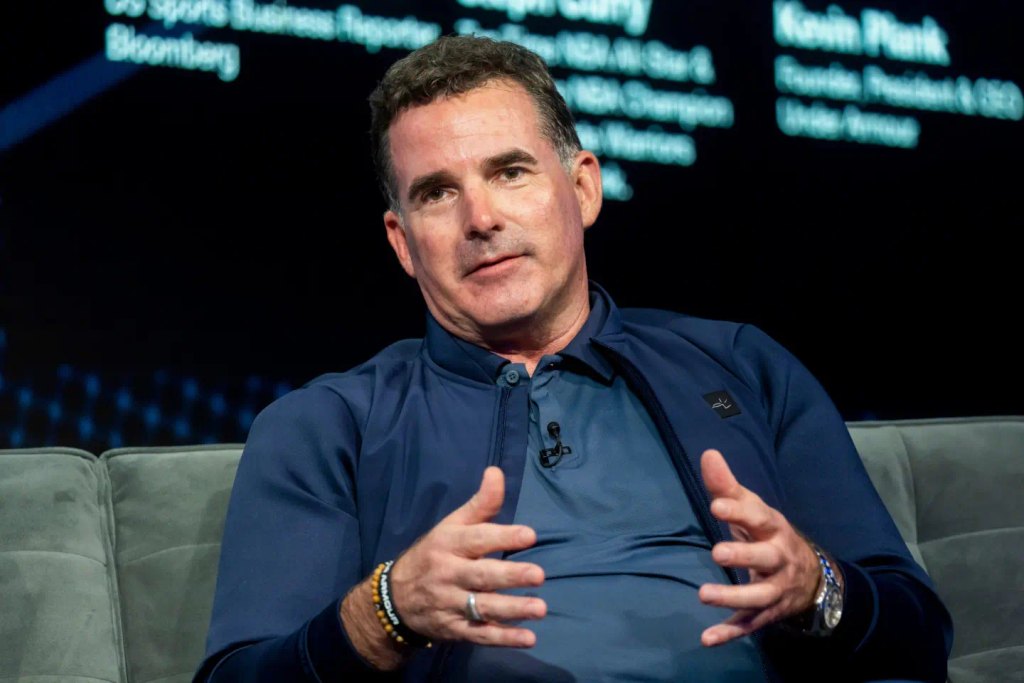
Plank’s idea came from an everyday irritation on the football field. More precisely, a cotton shirt that became heavy with sweat. The former University of Maryland player experimented with fabrics to produce a close-fitting shirt that kept athletes drier.
His advantage was access. Former teammates had reached professional football, giving him people who could try the product. He sent out samples and approached college equipment managers, according to reports of his early business.
In a 2014 interview, Plank recalled approximately $15,000 in cash and $40,000 in credit cards. Kevin Plank’s credit cards story can make the launch sound like a single borrowed cheque. It was a combination of personal resources, borrowing, and selling enough shirts to keep going.
Reports put first-year sales in 1996 at $17,000. The immediate task was getting customers to pay for an unfamiliar product. A useful shirt, sold through people who understood its purpose, gave the young business a foothold.
By 2005, Under Armour had annual revenue of $281.1 million, up 37% from the previous year. Its November IPO priced shares at $13. The company received approximately $112.7 million after underwriting discounts, commissions, and offering expenses, according to its 2005 results filed with the SEC.
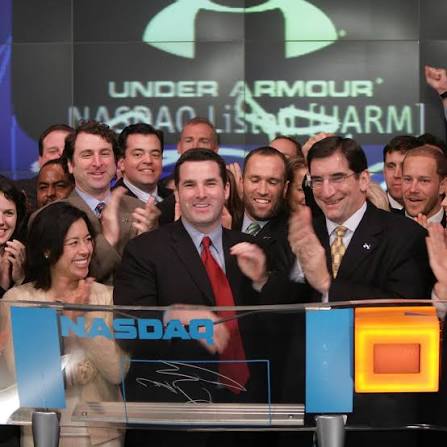
Some of that money immediately went towards the balance sheet. $37.2 million repaid a senior secured credit facility, while $12 million redeemed preferred stock held by Rosewood Capital.
It should be noted that Under Armour had moved beyond personal credit cards into institutional financing before public shareholders joined the story.
The growth continued. Revenue reached roughly $4.8 billion in 2016, an increase of about 22%. Under Armour had become a notable sporting-goods business, with ambitions extending well beyond its original shirt.
The slowdown became painfully clear in 2017. Under Armour’s annual filing shows revenue edged up to $4.98 billion, but operating income collapsed. Restructuring and impairment charges added to weaker North American performance.
The business was selling slightly more and earning dramatically less. It remains a useful warning for anyone judging the current recovery by revenue alone.
Plank returned as CEO on April 1, 2024, replacing Stephanie Linnartz. His second stint brought responsibility for repairing the company he had built. He added,
“For nearly 30 years, Under Armour has focused on inspiring athletes with industry-leading, performance solutions they never knew they needed and once they’ve tried them, can’t imagine living without. As the company continues to navigate several post-pandemic consumer, industry, and brand-specific factors, we are working hard to reconstitute our strengths and make thoughtful, balanced business decisions to drive enduring success for athletes, customers, and shareholders.”
The fiscal 2026 shareholder letter reported revenue down 4% to approximately $5 billion. Gross margin fell 2.4 percentage points to 45.5%, with higher tariffs identified as the largest source of pressure. Plank wrote,
“We’re not improving profitability fast enough.”
Under Armour had reduced its number of SKUs by approximately 25% over two years. Plank also pointed to running as an opportunity and apparel as a strength.
A smaller range can concentrate spending and make inventory easier to manage. The harder part is persuading shoppers to buy enough of those remaining products at full price. Cutting choice does not automatically create demand.
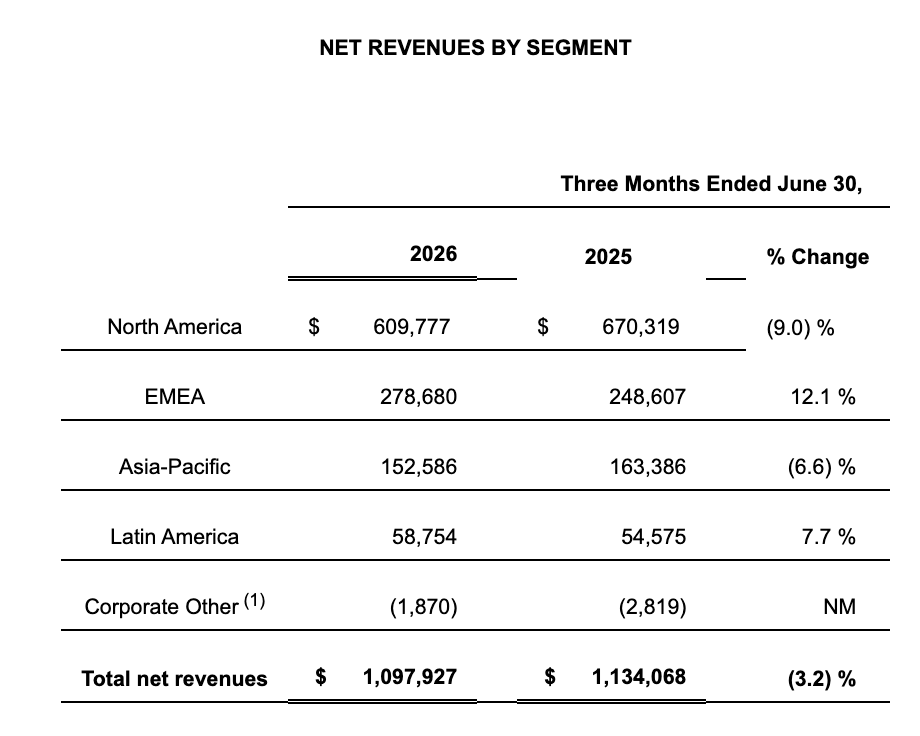
The August 7 fiscal Q1 2027 results showed that tension. Revenue fell 3% to $1.1 billion, including a 9% North American decline. Adjusted diluted EPS was $0.05, while reported diluted EPS rounded to zero.
Gross margin rose to 54.1%, but tariff refunds were the main driver. The question now is whether Under Armour can keep margins up without those refunds.
Under Armour’s November 6 earnings offered some relief, though sales continued to fall. Fiscal Q2 2027 revenue came in at $1.24 billion, down roughly 7% from a year earlier but above expectations of approximately $1.23 billion. Adjusted earnings per share rounded to $0.00, beating forecasts for a one-cent loss.
Adjusted operating income reached $24.9 million. Adjusted gross margin slipped 0.3 percentage points to 47%. North America remained a problem. Revenue in the region fell 6.9% to $737.2 million. Sales also declined in Europe, the Middle East and Africa, and Asia-Pacific. Latin America grew 3% to $55.4 million.
The next quarter looks difficult, too. Under Armour forecasts an adjusted loss of one to three cents per share for fiscal Q3, against expectations for a five-cent profit. Adjusted operating income could range from a $5 million loss to a $5 million profit.
For the full year, management maintained adjusted EPS guidance of $0.08–$0.12 and adjusted operating income of $140 million–$160 million. Revenue is still expected to decline at a mid-single-digit percentage rate.
That leaves Plank with more work to do. Under Armour performed better than analysts expected this quarter, but falling sales and the weaker Q3 outlook make it difficult to call a recovery.
Under Armour shareholders have had a better year than Nike investors, though neither investment has made money over the period. According to MarketCapOf’s ROI calculator, $5,000 invested in Under Armour’s stock on January 1 would be worth $4,783.03 by November 6, 2026. The same investment in Nike (NKE) would stand at $3,055.46. That works out to losses of approximately 4.34% and 38.89%, respectively.
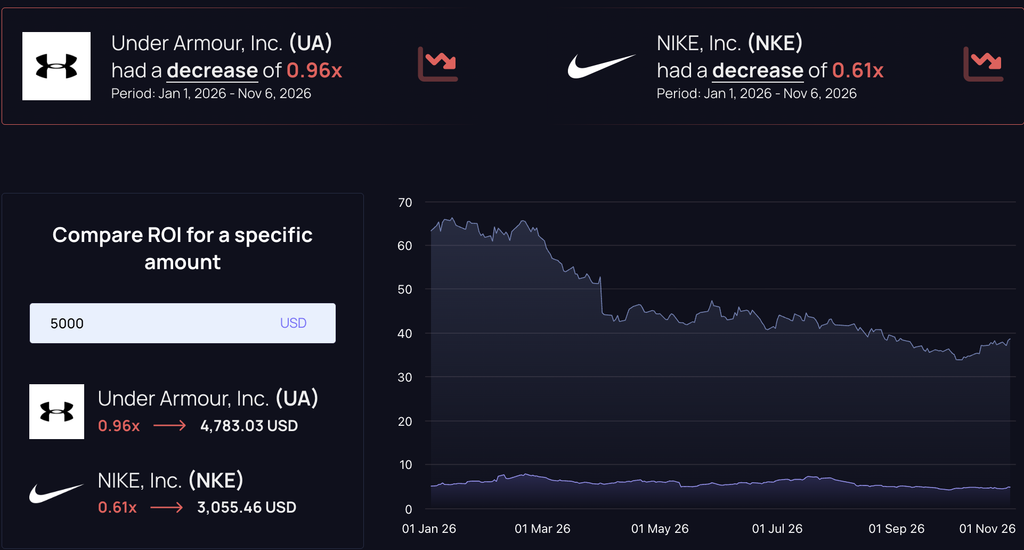
The latest earnings give investors a reason to keep watching, but sales are still shrinking, and management expects an adjusted loss next quarter. Under Armour remains a bet on Plank’s ability to rebuild demand, with further setbacks possible.
Plank once needed athletes to take a chance on an unfamiliar shirt. Today, he needs them to choose Under Armour again in a crowded market. Shareholders will know his comeback is working when that choice starts showing up in stronger sales and profits.
Also Read: Michael Saylor Predicts 3-Year Bitcoin Bull Run as US Midterms Reshape Crypto Outlook

Written by Sahana Kiran
Sahana Kiran has been covering financial markets since 2019, with a focus on cryptocurrencies, fintech, and the geopolitical events shaping them. She previously reported for AmbCrypto and Watcher Guru, and now writes for MarketCapOf.