


Defi
October 20, 2026
TRON TVL Hits $5.7B and Stablecoin Activity Surges, Can TRX Rally in 2026?

An OSMO price jump of 18.98% in 24 hours took the token to $0.0626 on October 27, right after Osmosis Proposal 1053 passed with 91.07% approval and switched OSMO inflation off. As BlockChainReporter reveals, the first zero-mint epoch followed the vote, taking daily issuance from about 91,324 OSMO to zero. Can OSMO catch UNI? Not any time soon. UNI’s market cap is about 109 times bigger right now, so every OSMO price prediction starts from that gap, and the OSMO vs Uniswap race now runs on fees, as the Osmosis forum proposal explains.
Also Read: TRON TVL Hits $5.7B and Stablecoin Activity Surges, Can TRX Rally in 2026?

The OSMO price jump came with real volume. At the time of the move, the token carried a $47.0 million market cap and 749.25 million coins in circulation, while 24-hour volume of $16.47 million equaled about a third of that. Right now, it trades near $0.0544 on MarketCapOf, still above its pre-vote level after the end of OSMO inflation.
According to GNcrypto, Osmosis Proposal 1053 collected 95.13 million yes votes, against 9.33 million abstentions, 2,340 no votes and 1,151 veto votes, with 65.52% turnout. The first epoch after passage minted zero OSMO, and the OSMO price jump followed within a day.
The Osmosis team stated on X:
“Flipped the switch. $OSMO inflation is off.”
In the same post, the team confirmed that the first epoch after the vote produced no new tokens, and that staking rewards now come only from protocol revenue.
The mint start epoch moved to 100,000,000, a level the chain never reaches, so no new OSMO is minted.
Daily minting fell from about 91,324 OSMO to nothing in the first epoch after passage.
Before the switch, OSMO inflation came from a mint module releasing about 121,766 OSMO a day. Staking took 8%, developer vesting took 25%, and the community pool kept 67% out of circulation as a soft burn. The developer share went to an address set by Proposal 997, so only about 40,000 OSMO a day reached the market, and the OSMO price jump came once Osmosis Proposal 1053 stopped it.
Those 40,000 daily tokens add up to about 14.6 million OSMO a year, just under 1.95% of circulating supply. With OSMO inflation at zero, burns from taker fees and ProtoRev revenue now cut supply in one direction only.
Osmosis team member Johnny Wyles, who posted the proposal on the Osmosis forum, stated:
“Every burn reduces supply. With no new issuance, all OSMO burned from taker fees and ProtoRev revenue directly reduces supply.”
That moves OSMO closer to capped assets such as Bitcoin, where scarcity backs the case some investors make against gold. Still, 51.9 million pre-minted OSMO sit in developer vesting, and releasing them needs a new vote, so the OSMO price jump does not erase every supply risk.
Issuance added about 2 points to staking APR, and Osmosis Proposal 1053 leans on a bigger taker-fee share to fill that hole.
Wyles had this to say in the proposal:
“Stakers continue to receive their share of taker fees and transaction fees. The roughly 2% APR from issuance ends. This is mostly replaced by the 1.7% additional estimated APR from the increased share of taker fees in Proposal 1052.”
That 1.7% comes from a DEX with about $11.2 million in TVL, and stakers will see it as a lower APR in their wallets. Fee-funded chains can work, as TRON shows with its network averaging 4.41M daily active accounts, but an OSMO price prediction that skips yield misses the test. If stakers unbond in large numbers, the OSMO price jump could fade fast.
The OSMO vs Uniswap matchup is where hype meets math. Uniswap (UNI) also ties value to fees, and as The Block reveals, Uniswap’s aggregator hooks went live on Ethereum, Base and Robinhood Chain on October 22, routing trades through Fluid, Curve and PancakeSwap with fees that feed UNI burns. Robinhood Chain also links Uniswap to a broker adding 10x leverage and AI-powered trading tools.
As KuCoin shows, this liquidity aggregation could sharpen the fight for DEX traffic, and its October 28 report listed OSMO among the top movers. NEAR adds pressure to the OSMO vs Uniswap contest too, with intent-based volume past $34 billion.
Size is the hard part of the OSMO vs Uniswap story. UNI traded at $7.11 with a market cap of about $4.44 billion on October 28, while OSMO at $0.054363 adds up to roughly $40.7 million. OSMO would need about $5.92 per token to match UNI, so one OSMO price jump barely changes any OSMO price prediction.
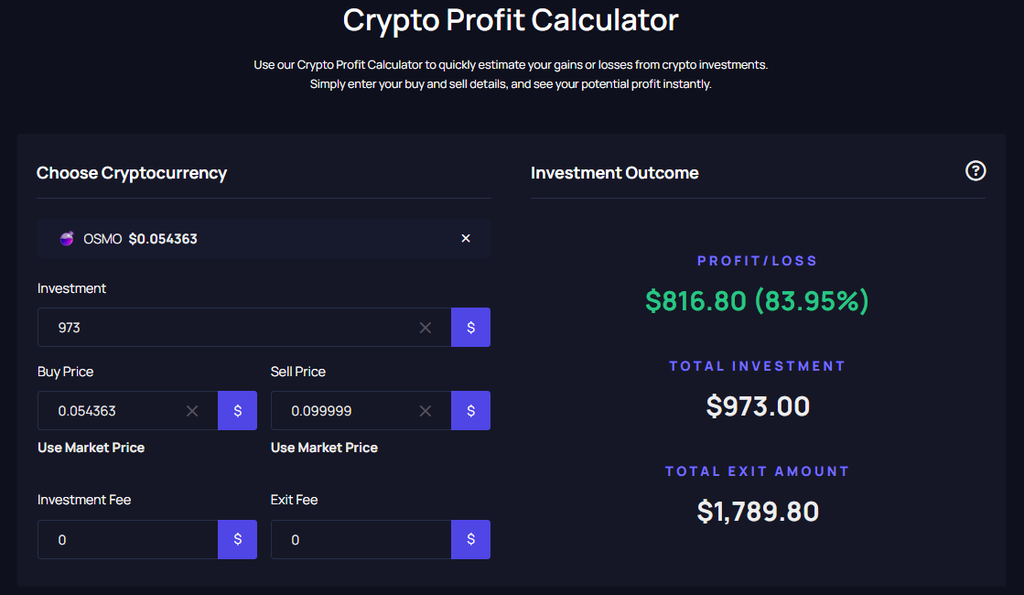
A more grounded OSMO price prediction uses smaller steps. The MarketCapOf Crypto Profit Calculator shows that a hypothetical $973 investment at the current $0.054363 price would reach $1,789.80 at $0.099999, a profit of $816.80, or 83.95%.
That target means about a $75 million market cap and an 84% rally, far beyond the OSMO price jump so far. BlockChainReporter’s math adds two marks: $0.125 equals about a $94 million market cap and $0.626 around $470 million.
OSMO was still down 52.3% over the past year as of October 27, so any OSMO price prediction has to price in deep losses for long-term holders. Exchange access matters too, and the exchange behind BNB still faces MiCA licensing pressure in Europe. Capital also has other homes, with Solana reporting a tokenized asset market of $4.3B, which keeps the OSMO vs Uniswap fight for money crowded.
Also Read: Crypto Vaults Grow From $4B to $10B as Investors Chase Higher Yields Amid Rising Risks
Three signals will decide whether the OSMO price jump holds. The first is staking APR over the next few epochs, since a revenue-funded rate that lands well below the old 2% could push stakers to unbond and sell.
The second is circulating supply on explorers, which should stay flat or slowly fall now that OSMO inflation is gone and every taker-fee and ProtoRev burn cuts supply directly. The third is any governance vote on the 51.9 million OSMO still sitting in developer vesting, because that pool is the last real source of new supply left after Osmosis Proposal 1053.
Bigger money keeps coming into crypto right now, and wealthy investors and institutions plan larger allocations, with institutional allocations at 11% on average and expected to climb toward 17% over the next three years. Most of that capital, though, flows into large caps with deep liquidity, and a DEX token worth about $40 million sits far from that list.
That ties the next OSMO price prediction to what Osmosis can earn on its own, from trading volume, taker fees and the burns they fund. For the OSMO vs Uniswap race, the zero-mint switch removes one weight from OSMO, and the next step is fee growth big enough to keep stakers paid and buyers interested.

Written by Vladimir Popescu
Vladimir Popescu leads editorial coverage at MarketCapOf, with over 8 years in financial and tech journalism. He previously held editorial leadership roles at Watcher Guru and Windows Report, and has been cited by Forbes for his crypto market coverage.