








Ethereum
September 29, 2026
Ethereum Price Faces $2,700 as Early Whale Sells Ahead of Glamsterdam

Ethereum co-founder Vitalik Buterin has once again ended up putting Ethereum’s future path back into the spotlight. Buterin has published a new essay, outlining his vision for Ethereum’s future. He shared how he envisioned Ethereum becoming a cryptographic world computer, the one that combines blockchain technology and cryptographic proofs. Other than that, Buterin also wants privacy tools and decentralized computing elements to be an essential part of the Ethereum 2030 future. Will such developments be able to impact the Ethereum price ahead?
Also Read: Kraken Financial Infrastructure Pivot Away From Retail to Focus on Institutional Investors
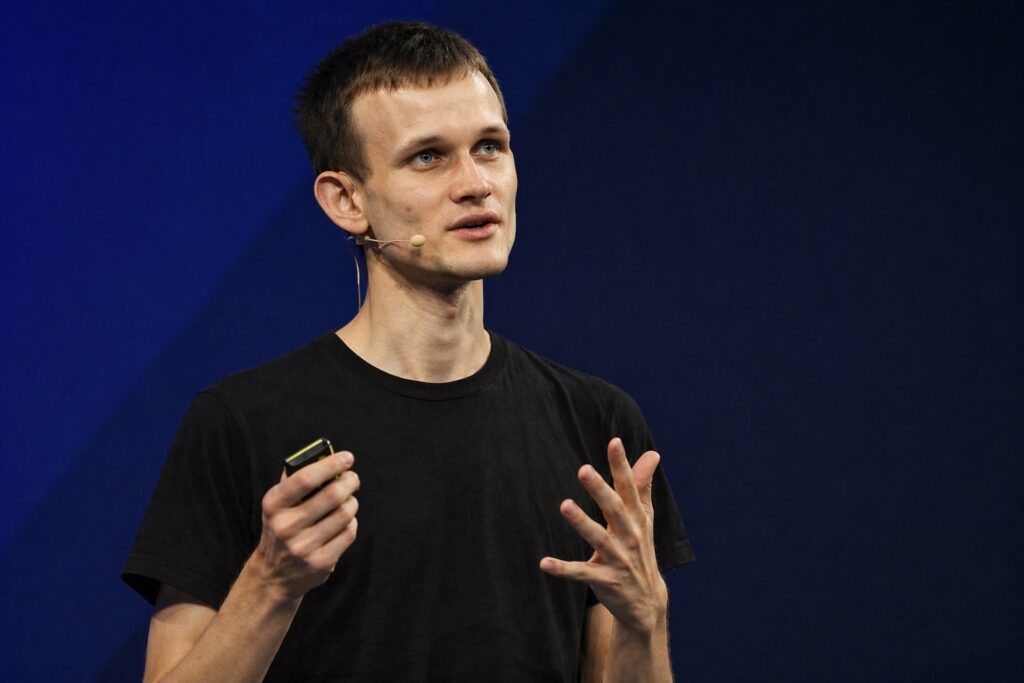
In a new essay shared by Buterin, the ETH co-founder outlined how he wants Ethereum to handle extensive work. However, he wants the blockchain to work without repeating the same calculations. Buterin wants to deploy cryptographic proofs with Ethereum so that the blockchain can perform large amounts of work, with evidence that it followed a standardized rulebook showcasing the mathematical proofs. Other computers can then later check these proofs to ensure accuracy, without having to repeat all the work in the process.
“This is the ‘cryptographic world computer’: a shift from Ethereum as solely a ledger onto which you can indiscriminately dump computation and data that gets executed to an architecture that combines blockchains with cryptographic privacy and verification and powerful decentralized off-chain components.”
This development is part of Ethereum’s 2030 vision and is intended to help the network become more scalable and efficient.
In addition to this, Buterin also outlined faster transaction processing as one of its core Ethereum 2030 evolutionary paths. He shared how he would like to include 4 to 8 second slots and a finality of roughly 8 to 32 seconds. This would mean that Buterin wants Ethereum to become so adept that it ends up creating new blocks every 4 to 8 seconds, while blocks could reach finality in roughly 8 to 32 seconds.
Another key component of the Ethereum 2030 plan is its privacy aspect. Buterin further emphasized Ethereum’s privacy, adding he would like to add cryptography to protect sensitive information such as wallet activity and user requests.
Also Read: Crypto Market Dominance Shift Accelerates as Bitcoin and Ethereum Lose 2.2% to Stablecoins
The Ethereum price is also being supported by growing activity around tokenization and real-world assets. Ethereum remains one of the largest networks for tokenized assets, with institutions using it for products linked to funds, Treasuries and other real-world assets.
Now that Buterin has outlined a new map of the Ethereum 2030 vision, it could strengthen Ethereum’s long-term narrative. However, these developments do not guarantee a higher Ethereum price. Crypto markets have always been volatile, so the narrative may change every second.
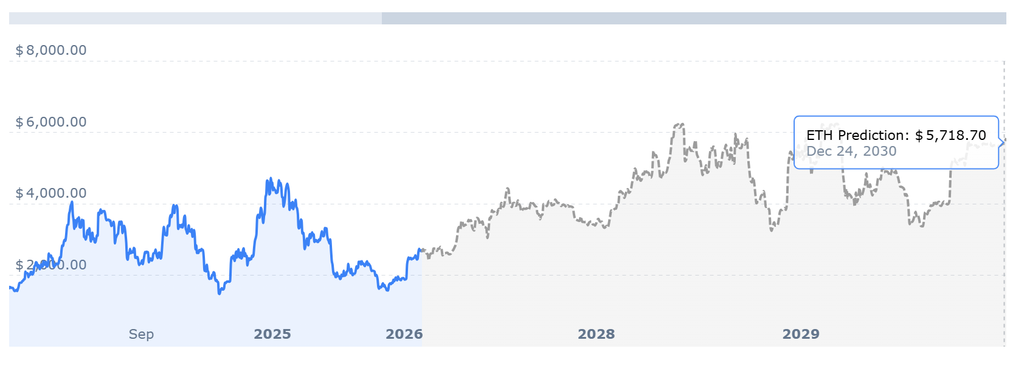
According to CoinCodex ETH Stats, Ethereum may hit a new price of $5,835 by 2030.
“Ethereum is forecasted to hit $3,032.39 by the end of 2026 (+14.49% compared to current rates), $5,885.53 by 2030 (+122.21%), $9,406.02 by 2040 (+255.13%), and $14,632 by 2050 (+452.46%).”
The CoinCodex model also projects that the token could reach around $4,013 by the end of 2027. These figures are model-based projections and should not be treated as guaranteed future prices.

Written by Juhi Mirza
Juhi Mirza is a crypto journalist and writer covering digital assets, blockchain, markets, and emerging trends in the Web3 industry.