Sui vs. Solana: Discover Which is Better for You
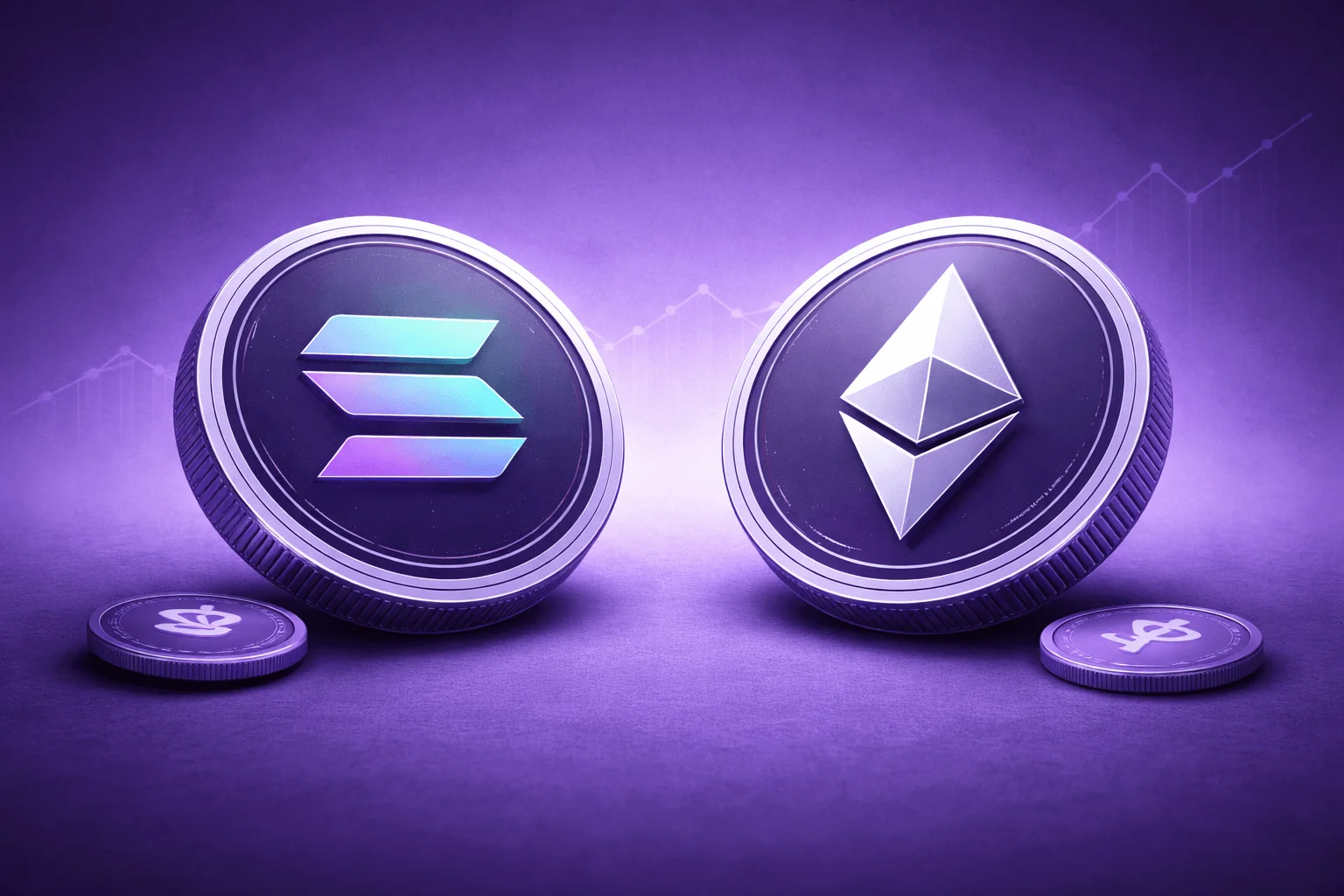
The cryptocurrency market continues to mature, and new Layer-1 networks are competing for attention. Right now, many investors in the crypto community are weighing SUI vs. SOL to decide where real long-term value lies.
Solana already has a strong ecosystem, deep liquidity, and broad adoption. That is why many choose to buy Solana when they want exposure to a mature smart contract platform.
At the same time, developers are actively evaluating Sui, attracted by its architecture and scalability. As more capital rotates across the market, the Solana comparison becomes more relevant for both users and builders.
This guide examines SUI vs. SOL using data, technical design, and real adoption metrics. You will see how both networks operate, scale, and fit into the broader blockchain ecosystem in 2026.
| Criterion | Sui (SUI) | Solana (SOL) |
|---|---|---|
| Price (at the time of writing) | ~$0.94 | ~$81 |
| Market Cap (at the time of writing) | ~$3 billion | ~$46 billion |
| Circulating Supply (at the time of writing) | ~3.84B SUI | ~566M SOL |
| Maximum Supply | 10B SUI | No fixed max supply (inflationary, decreasing issuance) |
| Blockchain | Sui Layer 1 blockchain | Solana Layer 1 blockchain |
| Consensus Mechanism | Modified Proof-of-Stake and Mysticeti (Narwhal & Bullshark) | Proof-of-Stake and Proof of History |
| Cryptographic Algorithm / Design | Object-centric model and Move VM | Account-based model and Sealevel runtime |
| Token Utility | Governance, staking, gas fees, ecosystem incentives | Staking, gas fees, governance, ecosystem incentives |
| Founders | Mysten Labs (Evan Cheng, Adeniyi Abiodun, Sam Blackshear, George Danezis) | Solana Labs (Anatoly Yakovenko, Raj Gokal) |
| Launch Date | May 3, 2023 | March 16, 2020 |
| Supporting Exchanges | Binance, Coinbase, OKX, Bybit, KuCoin, Kraken, Gate.io, MEXC, etc. | Binance, Coinbase, OKX, Bybit, Kraken, KuCoin, Bitfinex, Crypto.com, etc. |
| Communities | X (Twitter), Discord, Telegram, GitHub | X (Twitter), Discord, Telegram, Reddit, GitHub |
What Is Solana (SOL) and How Does It Work?
Solana is a Layer-1 smart contract platform built to optimize transaction ordering and execution at the protocol level. It was launched in 2020 by Anatoly Yakovenko and designed to overcome the scalability limitations of earlier blockchains.
Solana Labs designed the Solana blockchain to reduce the coordination overhead that limits throughput on traditional Proof-of-Stake networks.
Most blockchains rely on validators to agree on transaction order during block production. Solana changes this flow by introducing Proof of History into its consensus mechanism. Proof of History generates a cryptographically verifiable sequence of hashes that establishes a deterministic order of events before consensus begins.
Validators then apply Proof of Stake to confirm state transitions in accordance with this predefined order. Because ordering occurs before validation, the network reduces validator communication during block confirmation. Solana offers one of the fastest blockchain networks and supports a robust ecosystem of over 200 projects, including major DeFi protocols and NFT platforms.
Solana uses an account-based model with a single shared global state. All smart contracts read from and write to this state, enabling direct composability between decentralized applications.
Solana’s Core Strengths
- Deterministic ordering via Proof of History;
- A two-layer consensus design separating ordering from validation;
- A single global state enabling cross-contract composability;
- Support for multi-program transactions within one execution context;
- High validator throughput on optimized hardware;
- Fast block production with short slot times;
- Proven operation at sustained high transaction volumes;
- Low fees and low transaction costs make it cost-effective for users and developers;
- Known for offering fast transaction speeds, supporting high throughput, and low latency.
These properties make Solana well-suited for tightly coupled DeFi protocols and high-frequency applications. Solana is ideal for high-frequency DeFi, NFTs, and rapid consumer apps.
Solana’s Main Criticisms
However, this architecture introduces measurable constraints. Key limitations and risk factors include:
- Global state contention occurs when many transactions compete simultaneously;
- Performance sensitivity during traffic spikes;
- Validator participation requires high-performance hardware, with Solana validators needing intensive hardware and an estimated initial setup cost of over $10,000;
- Limited execution isolation between unrelated transactions;
- Increased complexity in validator client software;
- Higher operational costs for validators;
- Dependence on synchronized validator performance;
- Network stability and scalability challenges that may impact long-term adoption and reliability.
These trade-offs shape how Solana behaves under sustained load. They are explored further in later sections.
What Is Sui (SUI) and How Does It Work?
Sui is a Layer 1 blockchain launched in May 2023 by Mysten Labs, focused on optimizing smart contract performance and improving the scalability of decentralized applications (dApps) by minimizing unnecessary consensus.
Mysten Labs designed the Sui network to distinguish between transactions that require shared agreement and those that do not.
Traditional blockchains require all transactions to reach global consensus, regardless of their dependencies. Sui avoids this by using an object-centric architecture and object model, where assets exist as on-chain objects with explicit ownership and access rules.
This object model enables horizontal scaling by allowing independent processing of transactions involving different objects, reducing reliance on complex consensus mechanisms. Transactions that modify only owned objects do not enter global consensus.
It employs a unique consensus engine called Mysticeti, which separates transaction dissemination from ordering, allowing for high throughput. Sui also uses a modified Proof-of-Stake (PoS) model, and its consensus mechanism enables high transaction speeds, energy efficiency, and network security.
Sui decentralization is achieved through a validation process involving approximately 100 permissioned validators and its unique consensus engines, Narwhal and Bullshark, which, together with its object-centric security model, enhance the network’s security, scalability, and decentralized nature.
Sui’s Core Strengths
Sui emphasizes execution isolation and protocol-level efficiency. Core strengths include:
- Selective consensus based on transaction dependency;
- Parallel execution for independent object updates;
- Parallel processing enables Sui to process multiple transactions simultaneously, increasing throughput and scalability;
- Ability to handle both simple and complex transactions, with complex transactions requiring more sophisticated processing techniques;
- Object-level ownership enforced by the runtime;
- Strong safety guarantees through Move’s resource semantics;
- Reduced validator coordination for simple transactions;
- Sui offers a theoretical maximum of up to 120,000 TPS for simple transactions due to its parallel execution model;
- Horizontal scalability through execution separation;
- Predictable execution behavior under load.
These characteristics favor applications with large volumes of independent user actions.
Sui’s Limitations
At the same time, Sui’s model introduces constraints. Key limitations and risk factors include:
- A non-account-based execution model unfamiliar to many developers;
- Increased complexity around object lifecycle management;
- Fewer established design patterns compared to older chains;
- A smaller validator and developer ecosystem;
- Additional protocol components to manage execution paths;
- Less historical data from prolonged peak-load conditions, raising questions about network stability and scalability challenges;
- Tooling and infrastructure are still maturing;
- SUI is still in its early stages of development, with a rapidly expanding ecosystem, especially in gaming and DeFi, which may impact adoption and long-term growth.
These factors influence adoption and development workflows. They are addressed more thoroughly in later sections.
Solana vs. SUI: Technical Comparison
Transaction Processing Speed
In terms of transaction speed, both Sui and Solana are recognized as some of the fastest blockchain networks, offering high throughput and low latency for decentralized applications.
Solana processes transactions sequentially through a shared global state. Under normal conditions, the Solana blockchain confirms transactions in 400–600 milliseconds. During high activity, confirmation times can stretch as validators prioritize transactions with higher fees.
The Sui network separates transactions by dependency. Simple transfers and object-owned actions execute in parallel and often reach instant finality in under 300 milliseconds. Only shared-object transactions require consensus.
Sui provides sub-second finality for simple transactions and approximately 2-3 seconds for complex ones, while Solana achieves block finality in about 12.8 seconds.
Throughput and Scalability
According to Chainspect data (30-day average, February 2026), Solana processes around 1,264 real-time transactions per second, while Sui averages approximately 35.7 TPS. Over shorter peak windows (100 blocks), Solana reaches about 5,289 TPS, compared to Sui’s 926 TPS.
Likewise, transaction volume follows the same pattern, with Solana processing roughly 3.28 billion transactions over 30 days, compared with 92.5 million on Sui.
These figures show that Solana currently handles significantly more live transaction flow, driven by higher network usage and broader application activity.
However, it’s important to note that Sui leverages parallel processing by categorizing transactions into simple and complex types, allowing many transactions to be processed simultaneously. In contrast, Solana processes all transactions in a single shared state, which can introduce scalability limitations similar to those faced by earlier blockchains.
At the same time, theoretical capacity tells a different story. Solana’s architecture has a maximum theoretical throughput of around 65,000 TPS, relying on fast block production and validator hardware optimization. Regarding the Sui TPS, it has a theoretical ceiling near 120,000 TPS, achieved by separating execution paths and allowing non-conflicting transactions to bypass consensus.
As a result, Solana scales primarily through vertical optimization under present demand, while Sui is designed to scale horizontally as parallel transaction volume increases.
Transaction Costs and Network Congestion
Generally, Solana transaction fees stay very low. Gas fees, which are the costs associated with executing transactions on both networks, are a key consideration for users.
Each Solana transaction pays a base fee of 0.000005 SOL (roughly $0.0005 at $100/SOL) or 5,000 lamports. When you compare Solana to other blockchains, its low fees and low transaction costs make it attractive for high-volume applications.
Solana’s average transaction fees are often below $0.05, but can spike during periods of network congestion. During busy periods, users can add priority fees (optional fees to speed up processing, usually under $0.01).
On the Sui network, transactions pay execution fees (for computation) and storage fees (for object size and persistence). Sui employs a dual-fee model that separates computation costs from storage costs, and users can receive rebates for deleted data, making the fee structure more flexible.
In practice, most Sui transactions cost fractions of a cent, commonly $0.0005–$0.003 per transaction. Sui has no priority fee system, since many transactions bypass consensus through parallel transaction processing, which limits congestion-driven fee spikes.
As a result, Solana usually has cheaper base fees, while Sui tends to offer more predictable costs under higher network activity.
Programming Languages and Smart Contract Compatibility
Solana relies on Rust as its primary programming language. Rust supports high performance and memory safety, which fits Solana’s parallel execution model.
Developers can also use C and C++, but Rust remains dominant due to better tooling and efficiency. However, Solana does not support EVM compatibility, so Ethereum smart contracts cannot be ported directly.
Sui, by contrast, uses the Move programming language, built for secure asset management. The Sui Move language is an object-centric variant of Move, specifically designed to improve asset safety and prevent security vulnerabilities in smart contracts.
Move enforces ownership and resource rules at the language level, reducing common smart contract risks. Sui’s object model enables horizontal scaling by allowing independent processing of transactions involving different objects, reducing reliance on complex consensus mechanisms.
SUI’s innovative architecture and the Move programming language offer a superior foundation for complex applications, potentially attracting developers. Like Solana, Sui does not support EVMs, but its object-centric design enables safer, more predictable execution.
Considering these, Solana favors performance-focused development with Rust, while Sui prioritizes security and clarity through Move, even though both require developers to adopt non-EVM tooling.
The Market Performance of SUI vs. SOL
Market Capitalization
As of February 6, 2026, Solana’s market cap is significantly larger than Sui’s, according to CoinMarketCap.
Solana’s total market capitalization sits around $46 billion (7th place), making it one of the top Layer-1 blockchains by network value. Meanwhile, Sui’s market cap is approximately $3 billion (24th place), reflecting a smaller but still notable presence in the crypto sector.
Solana’s larger market cap is supported by its longer track record, broader adoption, and deeper liquidity across DeFi, NFTs, and ecosystem tokens.
In contrast, Sui’s smaller market cap reflects emerging adoption, a focus on scalable, object-centric execution, and new developer interest.
Supply and Price Action
Looking at the token price and supply, Solana (SOL) trades near $81 per token, with a circulating supply of under 566 million. Meanwhile, Sui (SUI) is valued at around $0.94 per token, with a circulating supply of 3.84 billion SUI tokens.
Solana’s price history shows larger swings tied to broader market cycles and ecosystem news, while Sui’s price has generally remained closer to its genesis range as its adoption base grows.
Solana’s inflationary supply model gradually slows issuance, whereas Sui’s high total supply emphasizes predictable distribution and broader token availability.
Trading Volume and Market Sentiment
Solana continues to lead in market activity. Its 24-hour trading volume is about $13.52 billion, signaling deep liquidity and sustained participation from traders and institutions.
By comparison, Sui records around $2.28 billion in 24-hour volume, which is lower than Solana’s but still strong for a newer Layer-1 network.
Meanwhile, market sentiment aligns closely for both assets. Solana shows roughly 84% bullish sentiment, driven by its established role in DeFi, NFTs, and high-throughput applications.
Similarly, Sui also records about 84% bullish sentiment, reflecting confidence in its protocol design, scalability roadmap, and long-term adoption potential.
The data was taken over from CoinMarketCap.
Ecosystem and Adoption
The Solana ecosystem is one of the most established in the blockchain industry, boasting a wide array of decentralized applications, deep liquidity, and a robust developer community.
Solana’s low transaction fees and fast transaction speeds have attracted projects across DeFi, NFTs, gaming, and more. This established ecosystem provides users with a seamless experience and developers with proven infrastructure, making Solana a go-to platform for launching new crypto assets and decentralized applications.
Sui, on the other hand, is rapidly building momentum. While its ecosystem is still in its early stages, Sui has already attracted innovative projects and a growing developer base eager to leverage its unique object-centric model and parallel transaction processing.
Sui aims to offer even faster transaction speeds and lower costs, making it a compelling alternative for new decentralized applications as the network matures.
Solana vs. Sui: Recent Developments
Solana
- Institutional access: Launched an institutional trading program in early February 2026, improving access to liquidity, market data, and professional trading tools.
- Stablecoin growth: Recorded roughly $900M in stablecoin inflows in January 2026, leading Layer-1 networks and supporting tokenized assets and RWAs.
- Network activity: Daily active addresses increased by 50%+ year-to-date, signaling strong user and developer engagement.
- Market expansion: Ongoing ETF filings and new integrations continued to strengthen Solana’s presence in DeFi, payments, and institutional markets.
Sui
- Stablecoin traction: Stablecoin market cap on Sui reached around $500M, with USDC accounting for the majority of supply.
- Infrastructure upgrade: Introduced Tidehunter, a new storage engine designed to improve validator and full-node performance.
- Ecosystem access: Expanded exchange integrations, including broader support across trading and payment services. Sui’s expanded exchange integrations have made it easier for users to buy Sui (SUI) on various platforms, with secure storage options available.
- Forward focus: Positioned the network for agent-ready and AI-native applications, leveraging its object-centric design.
FAQ
Both Sui and Solana use Proof-of-Stake, but their security models differ. Solana benefits from years of real-world testing and a large validator set. Sui focuses on safer execution through its object-centric model and Move language, with around 100 permissioned validators and the Narwhal–Bullshark consensus. Both are secure, but Solana has a longer track record.
SOL has a higher market cap because the Solana ecosystem is larger and more widely adopted across decentralized finance, NFTs, and crypto assets. Higher usage increases demand for SOL tokens. By contrast, the SUI token operates in a newer network that is still scaling adoption and liquidity.
Some investors call Sui a potential Solana killer due to its horizontal scalability and ability to achieve high throughput through parallel transaction processing. However, replacing Solana would require matching its established ecosystem and developer base. Growth is possible, but dominance is not guaranteed.
Unlikely. In the long-term Sui vs Solana landscape, both networks target high throughput and blockchain scalability, but serve different developer priorities. The market tends to support multiple leading smart contract platforms rather than a single winner.
Yes. You can swap SOL for SUI on centralized exchanges or through a decentralized exchange that lists both tokens. Always confirm network selection and check transaction fees before completing the swap.
Final Verdict: Solana (SOL) vs. Sui (SUI)
When you weigh Sui vs. Solana in 2026, Solana holds the stronger position today.
The Solana blockchain leads in market cap, transaction volume, liquidity, and ecosystem depth. Its established ecosystem, deep DeFi activity, and sustained network usage give it a clear advantage in real adoption.
Thus, for investors seeking scale, liquidity, and proven demand, SOL remains the safer choice.
However, the Sui blockchain brings meaningful innovation. Sui prioritizes institutional-grade infrastructure and gaming use cases, supports high parallel concurrency, and explores protocol-level privacy for confidential transactions.
Moreover, zkLogin simplifies onboarding by allowing users to access decentralized applications with standard web credentials.
Thus, Sui lowers friction for non-crypto natives while targeting scalable, high-performance environments.
So, Solana currently wins on adoption and market strength. Yet Sui shows strong architectural potential and long-term upside. If Solana represents maturity and liquidity today, Sui represents structural scalability for tomorrow.