Best Crypto Portfolio Tracker Apps in 2026 (Compared & Reviewed)
Managing crypto across multiple exchanges and wallets gets messy fast. If you can’t see your entire crypto portfolio, total value, and unrealized gains in one place, portfolio tracking becomes frustrating. That confusion makes crypto portfolio management, tracking crypto transactions, and even crypto tax reporting harder than it should be. To fix that, we reviewed the best […]
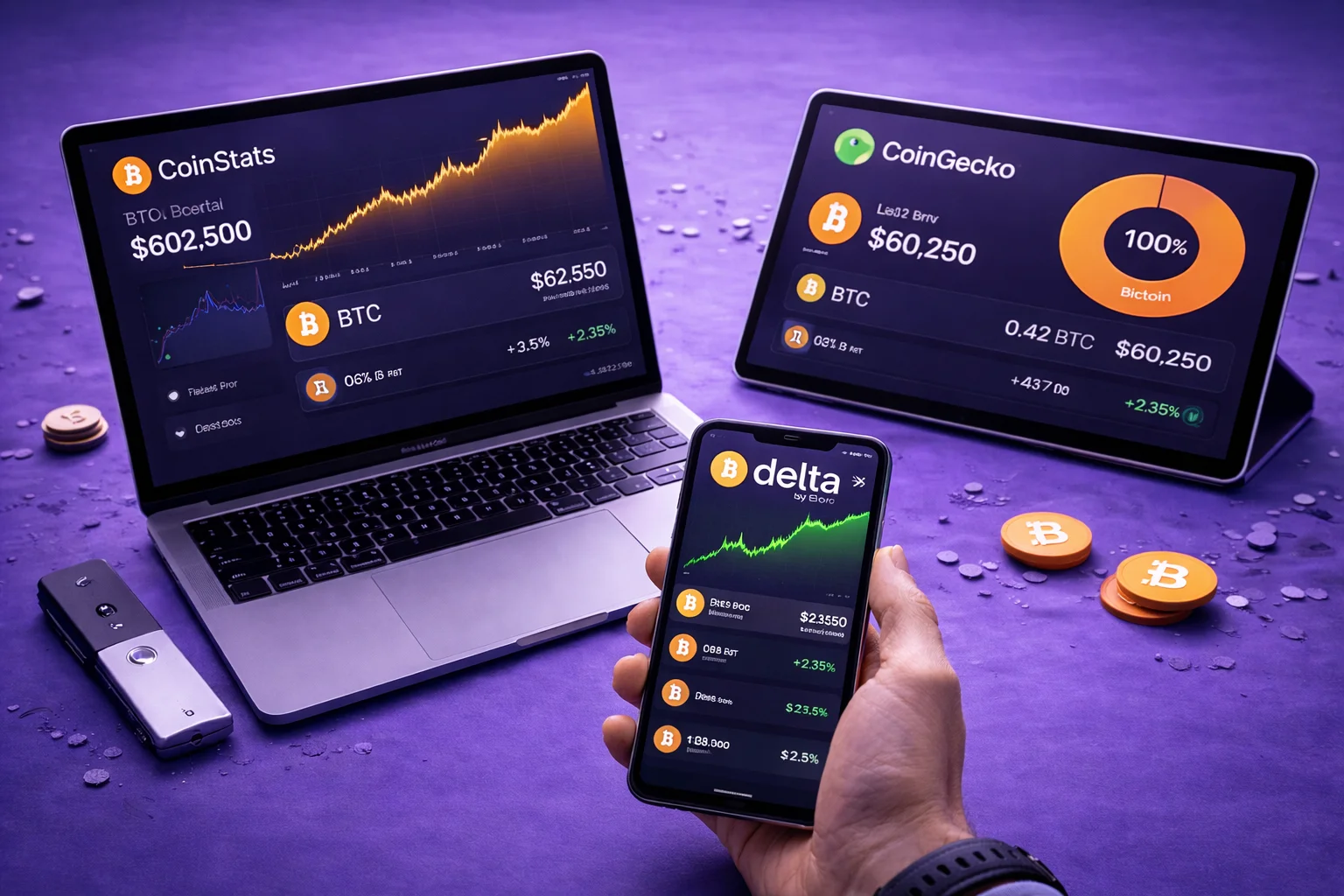
Managing crypto across multiple exchanges and wallets gets messy fast. If you can’t see your entire crypto portfolio, total value, and unrealized gains in one place, portfolio tracking becomes frustrating. That confusion makes crypto portfolio management, tracking crypto transactions, and even crypto tax reporting harder than it should be.
To fix that, we reviewed the best crypto portfolio tracker apps in 2026 so you can choose the one that best suits your needs.
Best Crypto Portfolio Tracker Apps At a Glance
| Platform | Benefits |
|---|---|
| CoinStats | • Best For: All-around crypto portfolio tracking across exchanges, wallets, DeFi & NFTs • Price: Free plan available; Premium ~$11.99/mo or ~$89/month • Supported Connections: 300+ exchanges and wallets via read-only API or public wallet address • Available On: iOS, Android, Web |
| Delta (by eToro) | • Best For: Investors beyond crypto • Price: Free plan; Pro ~$6.99/mo or ~$13.99/month • Supported Connections: 300+ crypto exchanges and supported broker integrations (read-only API) • Available On: iOS, Android, Desktop (Web) |
| CoinGecko Portfolio | • Best For: Manual (independent) crypto portfolio tracking • Price: Completely free • Supported Connections: No exchange API access; manual entry only (10,000+ supported tokens) • Available On: iOS, Android, Web |
| CoinMarketCap Portfolio | • Best For: Crypto beginners who want integrated free market data • Price: Completely free • Supported Connections: No API keys or wallet sync; manual entry only (thousands of listed assets) • Available On: iOS, Android, Web |
| Kubera | • Best For: High-net-worth investors consolidating crypto with traditional assets • Price: Essentials for ~$249/year or Black for $2499/year (no free tier) • Supported Connections: 20,000+ banks globally via Plaid, crypto exchanges & wallet address tracking • Available On: Web (mobile-responsive) |
| CoinTracker | • Best For: US-based investors seeking portfolio tracking with tax alignment • Price: Free limited tracking; Paid plans start ~$59/year • Supported Connections: 500+ crypto exchanges & wallets via API or public address sync • Available On: Web (mobile browser support) |
| Koinly | • Best For: Tax-focused investors needing cost-basis-accurate portfolio aggregation • Price: Free tracking; Paid plans start ~$49/year (scales with transactions) • Supported Connections: 700+ crypto exchanges, wallets & blockchain networks via API or wallet address • Available On: Web browser only |
CoinStats: Our Top All-Around Crypto Portfolio Tracker Choice
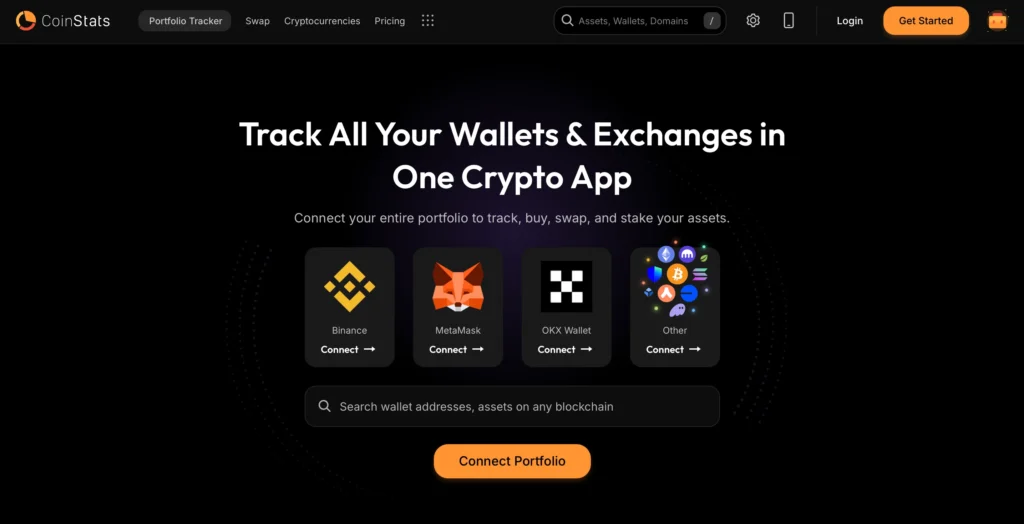
Founded in 2017 and headquartered in Yerevan, Armenia, CoinStats is a privately held company that has raised venture capital to scale its infrastructure and product offering.
The platform evolved from a basic platform into a full-featured crypto tracker and portfolio management app designed specifically for digital assets, and it remains independent rather than being absorbed into a trading venue or brokerage.
CoinStats operates as a non-custodial aggregator, so it does not request private keys and relies exclusively on read-only API integrations or public wallet address indexing. Moreover, the platform has built a large retail user base over several years, particularly among multi-exchange crypto investors.
The app store ratings remain consistently high, and the product continues to receive updates across mobile and web environments.
CoinStats Pricing
CoinStats runs on a freemium structure. The free version includes basic tracking with a limited number of exchange and wallet connections.
Its Premium plan costs around $11.99 per month or approximately $89.99 per month, unlocking expanded connection limits, advanced analytics, enhanced alerts, and additional portfolio insights.
Core Features of CoinStats
- Read-Only API & Wallet Address Integration – Connect 300+ exchanges and wallets using read-only API keys or public blockchain addresses. The system does not request private keys and cannot initiate transactions.
- Blockchain-Level Asset Detection – For supported chains, the app pulls on-chain balances directly from public blockchain data when wallet addresses are provided.
- Real-Time Profit and Loss Engine – Calculates realized and unrealized gains using trade history imports, factoring in cost basis and transaction fees where available.
- Support for 20,000+ Digital Assets – Tracks a broad range of cryptocurrencies, including ERC-20 tokens and other major network standards.
- DeFi and NFT Monitoring – Displays the balances of decentralized finance (DeFi) tokens and NFT holdings from supported wallets in a single portfolio view.
- Customizable Price Alert System – Users can configure alerts based on fixed price levels or percentage movements, delivered via mobile notifications.
- Historical Performance Charts – Interactive charts allow time-based filtering for portfolio growth analysis across custom periods.
- Multi-Currency Reporting – Portfolio valuation can be displayed in multiple fiat currencies for localized performance tracking.
Want a deeper look at how it works? Read our full CoinStats review for a detailed analysis.
Delta: Our Portfolio Tracker Choice for Investors Beyond Crypto
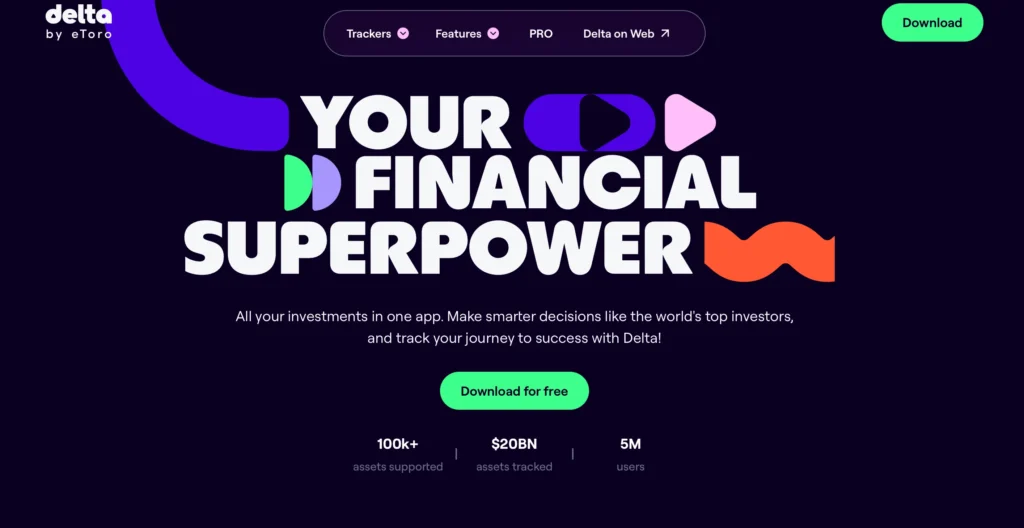
Delta was launched in 2017 and later became part of the eToro Group in 2019. As a result, it operates under the ownership of an established global brokerage rather than as an independent crypto startup.
While it began as a cryptocurrency tracker, Delta repositioned itself as a cross-market portfolio monitoring tool. Instead of focusing purely on digital assets, it now supports traditional financial instruments alongside crypto, targeting investors who allocate capital across multiple markets.
Importantly, Delta does not function as a broker or exchange. It aggregates data without holding assets and connects to external platforms through restricted-access integrations. In other words, the account custody remains entirely with the user’s exchange or brokerage.
The platform maintains strong app store ratings globally and has consistently focused on refining its user interface and reporting depth, particularly for mobile-first investors.
Delta Pricing
Delta offers a free tier with core tracking functionality and limited synced accounts.
For expanded features, Delta Pro costs approximately $6.99 per month, while Delta Pro+ costs around $13.99 per month. Additionally, higher tiers increase connection limits, unlock deeper analytics, and enable advanced insight tools.
Core Features of Delta
- Cross-Market Portfolio Consolidation – Combines cryptocurrencies, publicly listed equities, ETFs, indices, commodities, and select forex instruments into a single reporting structure.
- Restricted API Connectivity – Connects to supported exchanges and brokerages using permission-limited API keys that do not allow order placement or fund withdrawals.
- Performance Attribution Framework – Tracks realized and unrealized returns with time-based filtering, enabling investors to analyze performance across specific market cycles or holding periods.
- Corporate Action Handling – Accounts for dividends, stock splits, and fee structures within supported integrations to preserve return accuracy.
- Asset Allocation Visualization – Provides structural breakdowns by asset category and position weight to evaluate exposure concentration.
- Multi-Portfolio Structuring – Enables separation of holdings into distinct portfolios for strategy-based or account-based segmentation.
- Event-Driven Market Context Layer – The Pro tier includes analytical overlays designed to explain price movements affecting portfolio valuation.
- Price Notification System – Allows configuration of asset-level alerts across both crypto and traditional instruments.
- Device-Level Data Consistency – Synchronizes portfolio data across iOS, Android, and desktop interfaces to maintain reporting continuity.
CoinGecko Portfolio: Our Top Pick for Manual Portfolio Tracking
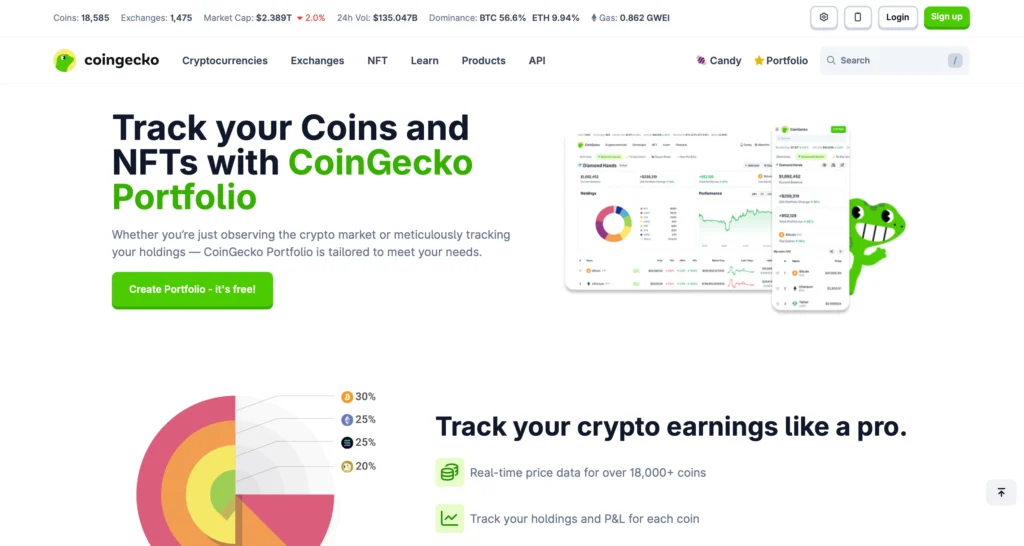
CoinGecko is one of the longest-operating independent crypto data aggregators in the industry. Headquartered in Malaysia and privately owned, the company built its reputation on transparent market data.
Unlike portfolio apps that rely on API syncing, CoinGecko’s Portfolio feature is integrated directly into its market data platform. So, instead of functioning as a separate financial tool, the portfolio system sits alongside price charts, token metrics, liquidity data, and exchange listings.
Moreso, CoinGecko does not request exchange API keys or wallet connections for its portfolio feature. Everything is manually entered, which removes API-based risk entirely.
Over the years, CoinGecko has maintained strong credibility within crypto-native communities, particularly among users who value independent data aggregation over exchange-affiliated analytics.
CoinGecko Portfolio Pricing
CoinGecko’s portfolio feature is completely free to use.
Core Features of CoinGecko Portfolio
- Manual Transaction Entry System – Users log buys, sells, and transfers manually, including price, quantity, date, and fees. No API connections or wallet access required.
- Real-Time Price Integration – Portfolio valuations update automatically based on CoinGecko’s live market pricing across thousands of cryptocurrencies.
- Support for 10,000+ Tokens – Tracks a wide range of listed assets, including long-tail tokens available within CoinGecko’s market database.
- Profit and Loss Calculation – Estimates total portfolio value and calculates overall gains or losses based on entered transaction history.
- Multi-Portfolio Creation – Allows users to create separate portfolio buckets for different strategies or accounts.
- Fiat Currency Conversion – Displays portfolio value in multiple fiat currencies using live exchange rate data.
- Browser and Account Syncing – Portfolio data is tied to a CoinGecko account and accessible across devices via web login.
- Integrated Market Data Context – Because the portfolio sits inside the broader CoinGecko platform, users can immediately reference token metrics, liquidity scores, and historical charts.
CoinMarketCap Portfolio: Our Choice for Beginners and Free Market Data
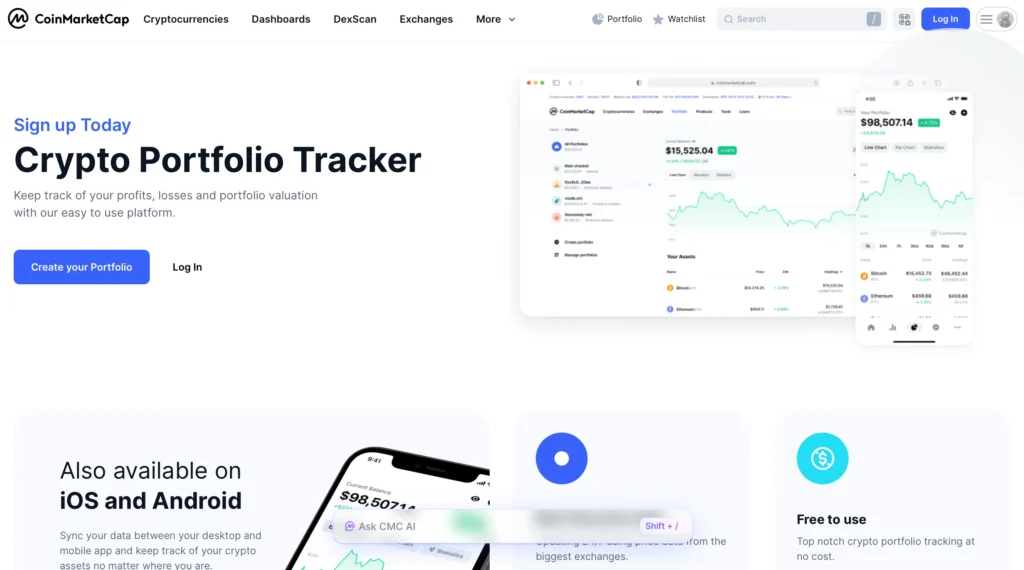
Founded in 2013, CoinMarketCap is one of the earliest cryptocurrency market data aggregators. In 2020, it was acquired by Binance, placing it under the ownership of one of the largest global crypto exchanges.
The Portfolio feature is embedded directly into the CoinMarketCap ecosystem, similar in concept to CoinGecko’s approach. Rather than acting as a standalone portfolio management application, it functions as an extension of its token listing and pricing infrastructure.
CoinMarketCap Portfolio does not require API keys or wallet permissions. Like CoinGecko, users manually input transactions. That design eliminates exchange connectivity risk while keeping the tool lightweight and accessible.
Because CoinMarketCap remains one of the most visited crypto data websites globally, the portfolio feature benefits from immediate access to extensive token data, rankings, historical price charts, and market capitalization statistics.
CoinMarketCap Portfolio Pricing
CoinMarketCap Portfolio is also free to use.
Core Features of CoinMarketCap Portfolio
- Manual Portfolio Tracking – Users enter transaction details manually, including price, quantity, and timestamps, without linking exchanges or wallets.
- Live Market Price Synchronization – Portfolio valuations update automatically using CoinMarketCap’s real-time pricing engine.
- Extensive Token Coverage – Supports thousands of listed cryptocurrencies, including newly added tokens reflected in its database.
- Basic Profit and Loss Overview – Displays total holdings value and aggregate gain or loss based on entered transactions.
- Multiple Portfolio Creation – Users can create and manage separate portfolios for organizational purposes.
- Fiat Display Options – Allows valuation in various fiat currencies using current exchange rates.
- Web and Mobile Access – Accessible via browser login and synchronized with the CoinMarketCap mobile app.
- Direct Access to Token Metrics – Seamless navigation between portfolio holdings and detailed token pages with market cap, supply data, and charting tools.
Kubera: Our Choice for High-Net-Worth Portfolio Consolidation
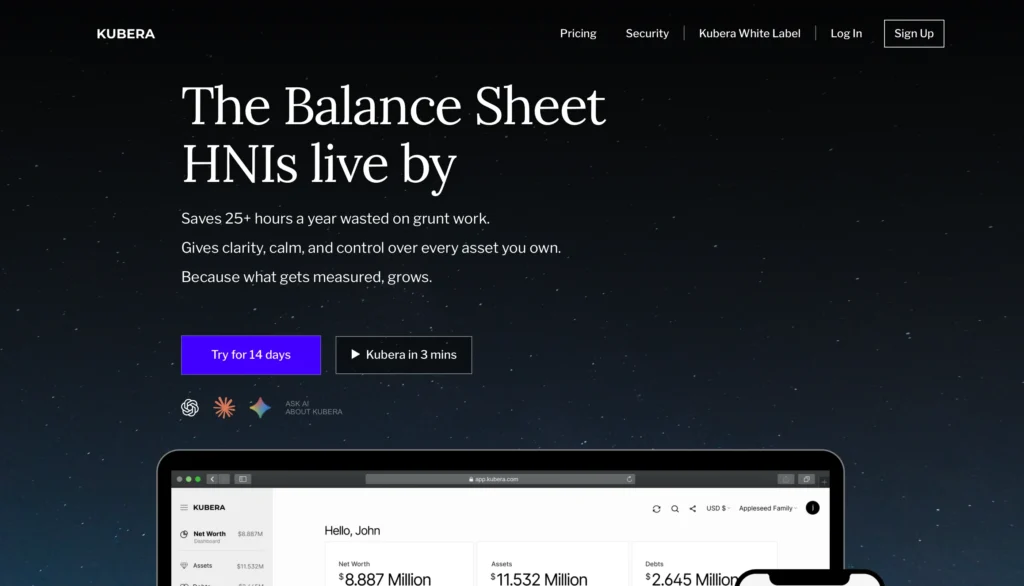
Founded in 2018 and headquartered in the United States, Kubera positions itself as a net-worth tracking platform rather than a crypto-native portfolio tracker. This means that, while it supports cryptocurrencies, its broader goal is full wealth visibility across asset classes.
Kubera is privately owned and operates on a subscription-only model, which naturally filters its audience toward investors who prioritize structured financial oversight.
We rank it fifth because, while technically capable, it is not purpose-built for active crypto investors. It appeals more to users who want digital assets tracked alongside traditional holdings in a consolidated net-worth view.
Kubera Pricing
Kubera does not offer a free tier. Its subscription costs around $150 per year, making it more expensive than most crypto-only trackers.
Core Features of Kubera
- Exchange & Wallet Connectivity – Supports crypto exchange API integrations and wallet address tracking for automatic balance updates.
- Multi-Asset Net Worth Dashboard – Aggregates crypto alongside stocks, ETFs, real estate, bank accounts, and alternative assets within one unified net-worth interface.
- Manual Asset Entry Flexibility – Allows manual addition of tokens or private investments that are not supported via the API.
- Real-Time Price Feeds – Pulls live crypto pricing data to update portfolio valuations automatically.
- Estate Planning & Beneficiary Access Tools – Includes secure document storage and legacy-planning features that are uncommon among crypto-focused trackers.
- Balance-Level Reporting – Displays allocation percentages and total portfolio valuation, but does not emphasize granular trading analytics.
EXTRA: CoinTracker, Top Choice for US-Based Crypto Investors
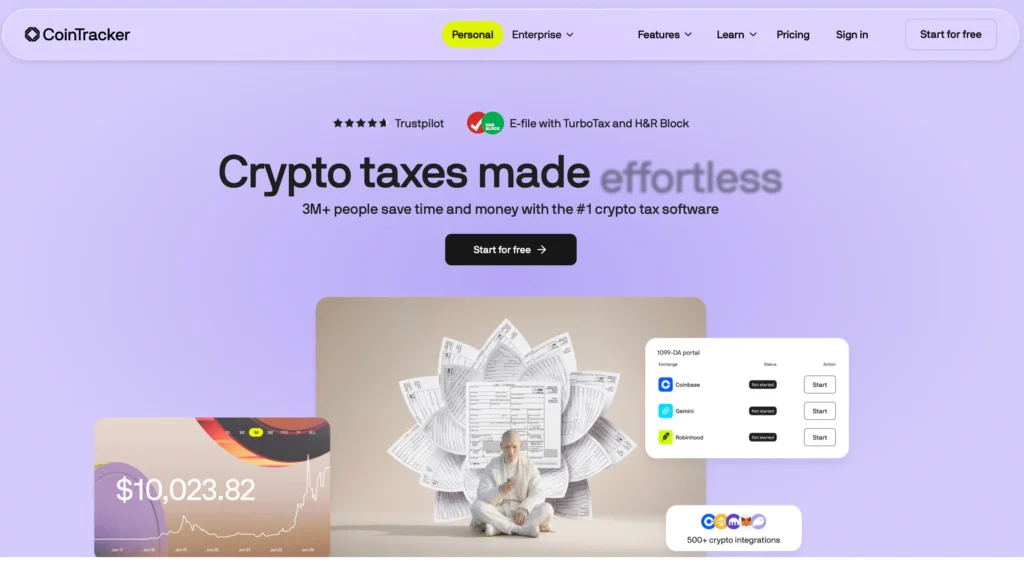
Founded in 2017 and based in the United States, CoinTracker operates at the intersection of portfolio aggregation and crypto tax reporting.
Like Koinly (which we will present below), its infrastructure was built with tax compliance in mind, but it offers a stronger portfolio monitoring layer than pure tax tools. Additionally, the platform connects to exchanges and wallets through API integrations and blockchain indexing. Its architecture is non-custodial, meaning it cannot initiate trades or withdrawals.
CoinTracker has gained significant visibility in the US market and has partnerships with major exchanges, which have contributed to its adoption. However, despite that traction, it ranks sixth because its primary strength remains tax calculation rather than advanced performance analytics for active portfolio management.
CoinTracker Pricing
CoinTracker offers limited free tracking for smaller portfolios. Paid plans start at around $59 per year and scale up based on transaction volume and tax reporting needs.
Core Features of CoinTracker
- Exchange & Wallet Syncing – Connects to major exchanges and public wallet addresses to automatically import transactions and balances.
- Real-Time Portfolio Dashboard – Displays total holdings value and tracks unrealized gains across synced accounts.
- Automated Cost Basis Tracking – Calculates gains using recognized accounting methods for accurate performance attribution.
- Transaction Classification Engine – Categorizes staking rewards, trades, transfers, and other events to preserve gain accuracy.
- Support for Thousands of Tokens – Covers a wide range of listed cryptocurrencies based on exchange and blockchain support.
- Tax-Integrated Performance View – Portfolio metrics align directly with tax calculations, ensuring reporting consistency.
EXTRA: Koinly, Our Choice for a Tracker Built on Tax Infrastructure
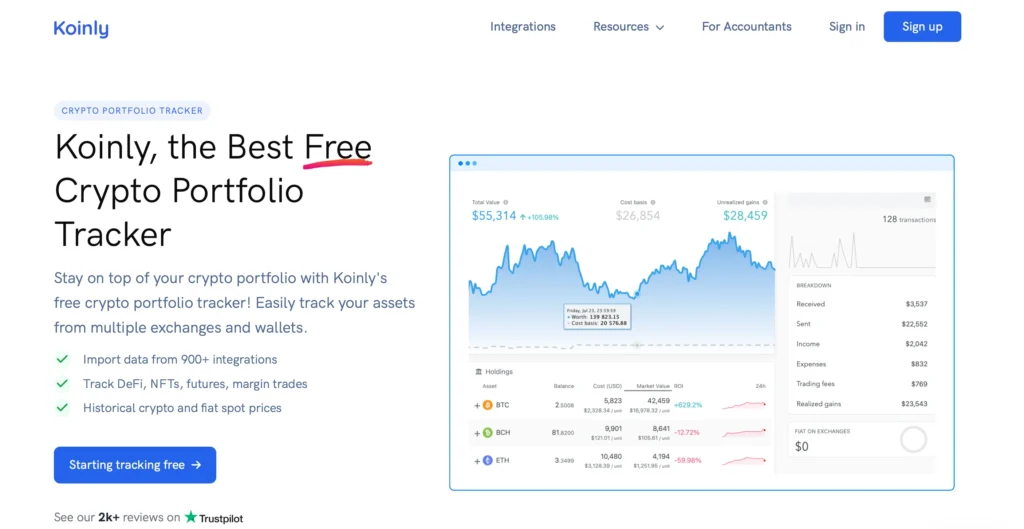
Founded in 2018 in the UK, Koinly is widely known as a crypto tax reporting platform. Thus, that foundation shapes how its portfolio tracking works. Unlike apps built primarily for performance monitoring, Koinly’s dashboard exists to support accurate transaction aggregation and cost basis calculation.
Moreover, the platform connects to exchanges and wallets via API or public blockchain addresses, then reconstructs your transaction history to calculate gains and losses. As a result, the portfolio view is structured around tax reasoning rather than market-centric analytics or trading insights.
While Koinly offers reliable balance aggregation and visibility into unrealized gains, it does not directly compete with platforms designed for active portfolio optimization. Also, its user base is more compliance-focused, which partly explains why it ranks lower in our portfolio tracker list compared to CoinStats, Delta, CoinGecko, or CoinMarketCap.
Koinly Pricing
Koinly allows users to sync wallets and view portfolio balances for free. However, full reporting functionality requires a paid annual plan based on transaction volume. Pricing typically starts around $49 per year and increases depending on the number of transactions processed.
Core Features of Koinly
- Exchange and Wallet Syncing – Connects to major exchanges and blockchain networks using API integrations or public wallet addresses to import transaction history.
- Automated Cost Basis Calculation – Calculates realized and unrealized gains using recognized accounting methods such as FIFO, LIFO, and average cost basis.
- Consolidated Portfolio Overview – Displays aggregated balances across synced platforms, including total holdings value and unrealized profit or loss.
- Transaction-Level Accuracy Controls – Identifies missing purchase history or inconsistent records that may affect gain calculations.
- DeFi and NFT Transaction Recognition – Imports supported DeFi interactions and NFT-related transactions, primarily for accurate gain classification.
- Multi-Currency Valuation – Allows portfolio valuation in different fiat currencies for reporting consistency.
FAQ
A crypto portfolio tracker is a tool that lets crypto investors monitor their entire crypto portfolio across multiple exchanges and wallet addresses in a single dashboard. It aggregates crypto data using read-only API keys or API access without custody of crypto assets. Most crypto portfolio tracker apps calculate total value, unrealized gains, capital gains, and portfolio performance to support effective crypto portfolio management.
If you hold crypto assets across multiple wallets, Trust Wallet, and major exchanges, manual portfolio tracking becomes inefficient. A portfolio tracker centralizes crypto transactions so you can track assets, monitor market trends, and manage your cryptocurrency portfolio properly. It supports price alerts, price targets, and better exit strategy decisions in the cryptocurrency market.
The top crypto portfolio tracker apps typically include CoinStats, Delta, CoinGecko Portfolio, CoinMarketCap Portfolio, and Kubera. For crypto tax software needs, CoinTracker and Koinly are strong options. The best crypto portfolio tracker depends on whether you prioritize crypto portfolio management, crypto tax reporting, or a free, manual-entry tracker.
The best crypto tracker should support auto-sync via secure API keys and wallet addresses across both crypto and centralized exchanges. It must track unrealized gains, capital gains, total value, and the portfolio’s performance with in-depth analytics. Advanced features include multiple portfolios, custom alerts, local fiat currency reporting, and the ability to import data for all my transactions.
Most safe-to-use crypto portfolio trackers use read-only APIs and never request private keys. They cannot withdraw funds from crypto exchanges or access crypto assets directly.
Yes, many crypto tracking apps offer a free crypto portfolio tracker through a free plan or free tier. Some platforms apply transaction limits or restrict advanced features unless you upgrade to a paid plan. A free tier works for basic portfolio tracking before moving to full crypto portfolio management tools.
Yes, most cryptocurrency portfolio tracker apps support multiple exchanges and wallets, either via API access or wallet addresses. This allows auto-syncing of crypto transactions into a single portfolio view. You can track your entire crypto portfolio, including digital assets held on-chain.
Yes, some platforms combine portfolio management with crypto tax software to generate a crypto tax report or a full tax report for tax season.
Conclusion
Now you know which crypto portfolio tracker apps stand out in 2026 and how they compare in pricing, features, and supported connections. Whether you need advanced crypto portfolio management, a free crypto portfolio tracker, or crypto tax software, the right tool depends on your setup.
We hope this guide helped you find the best crypto portfolio tracker for your portfolio and made the decision a lot easier.