ZEC vs XMR: Which Privacy Coin Is Better in 2026?
Financial privacy is becoming increasingly difficult to maintain as blockchain analysis tools grow more sophisticated. For many users, fully transparent transaction data is no longer acceptable when interacting with digital assets.
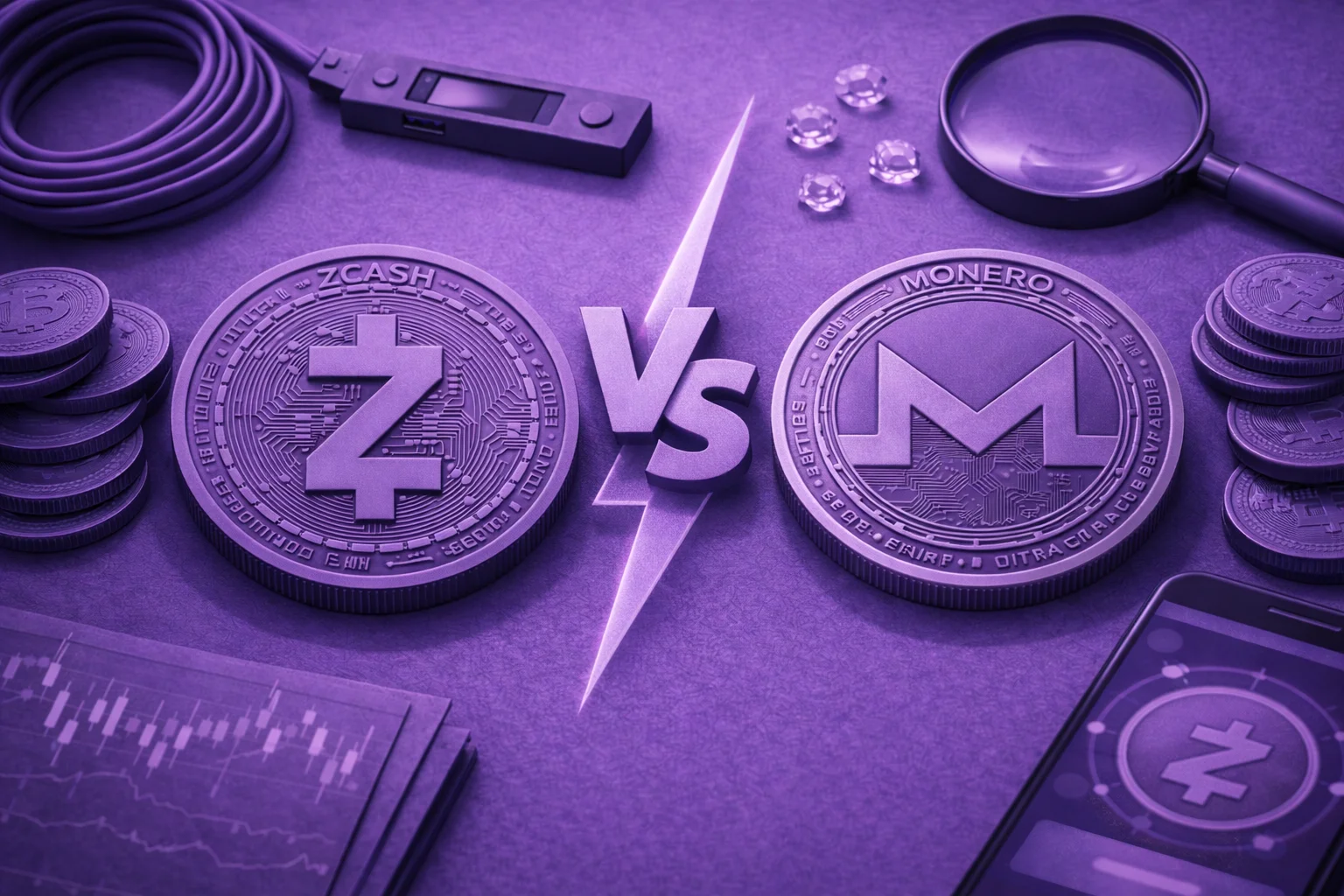
Choosing between ZEC vs XMR goes beyond price movements or past performance. It comes down to risk tolerance, regulatory pressure, and the level of privacy protection you truly need. This guide compares Zcash and Monero across privacy features, technology, adoption, and long-term viability to help you make a well-informed decision in 2026.
ZEC vs XMR: At a Glance Comparison
Zcash (ZEC)
- Primary goal: Balance financial privacy with regulatory compatibility;
- Block time: ~75 seconds;
- Emission model: Halving-based;
- Governance style: Foundation and company-led;
- Fee behavior: More stable fees;
- Exchange access: Widely available on major platforms.
- Learning curve: Moderate;
- Transaction size: Smaller in the transparent model.
Monero (XMR)
- Primary goal: Provide maximum financial privacy and anonymity;
- Block time: ~2 minutes;
- Emission model: Tail emission;
- Governance style: Community-driven;
- Fee behavior: Fees fluctuate with usage;
- Exchange access: Limited on regulated exchanges;
- Learning curve: Low for basic use;
- Transaction size: Larger due to built-in privacy.
What Is Zcash (ZEC) and How Does It Work?
Zcash is a privacy-focused digital currency that gives users control over how much transaction data they reveal. It was developed with support from the Electric Coin Company and the Zcash Foundation, aiming to balance financial privacy with regulatory compatibility.
Zcash is a proof-of-work cryptocurrency that uses zero-knowledge proofs to enable private transactions while still allowing transparent ones. Its dual address system allows users to choose between:
- t-addresses (transparent addresses);
- z-addresses (shielded addresses).
This design enables users to move between transparent and shielded transactions on the same blockchain.
Zcash’s Core Strengths
Zcash offers optional privacy through advanced cryptography. Key features include:
- Shielded transactions using zk-SNARKs;
- Selective transparency for compliance and audits;
- Selective disclosure of transaction data;
- Flexible privacy protection aligned with regulated exchanges.
Zcash’s optional privacy model appeals to many users who want control rather than enforced anonymity.
Zcash’s Main Criticisms
Zcash’s privacy model introduces trade-offs. Common criticisms include:
- Optional privacy weakens collective anonymity;
- Many users rely on transparent transactions;
- Shielded addresses remain underused;
- Zcash’s optional transparency exposes metadata risks.
As a result, Zcash’s privacy protection depends heavily on user behavior.
What Is Monero (XMR) and How Does It Work?
Monero is a digital cash system built for users who prioritize anonymity above all else. From its inception, Monero (XMR) was designed to prevent transaction tracing and blockchain surveillance, even under regulatory scrutiny.
It is a proof-of-work cryptocurrency designed for strong anonymity and default transaction confidentiality. It uses multiple privacy layers to automatically hide transaction details, without requiring user configuration.
Monero’s Core Strengths
Monero prioritizes anonymity at the protocol level. Key features include:
- Ring signatures and decoy transactions;
- Stealth addresses for recipient privacy;
- Ring Confidential Transactions (RingCT);
- Dynamic block size to adapt to demand;
This design makes Monero highly resistant to blockchain analysis and well-suited for users prioritizing anonymity.
Monero’s Limitations
Monero’s design also introduces constraints. Limitations include:
- Higher transaction fees during congestion;
- Larger transaction size affecting speed;
- Ongoing regulatory pressure;
- Limited access on major platforms;
Despite this, Monero continues to see rising demand driven by real-world use cases.
Privacy Features Compared
Privacy is the core differentiator between Zcash and Monero. While both aim to protect transaction data, they apply privacy in fundamentally different ways, which directly impacts anonymity strength, usability, and risk exposure.
1. Default vs Optional Privacy
The most important difference lies in how privacy is applied.
- Zcash treats privacy as an optional feature. Users must actively choose shielded transactions.
- Monero enforces privacy by default for every transaction.
Why this matters: Optional privacy creates fragmentation. When many users choose transparent transactions, the overall anonymity set becomes smaller. Enforced privacy, on the other hand, strengthens collective anonymity because all users look the same on-chain.
2. Metadata and Traceability Risks
Privacy is not only about hiding amounts but also about limiting metadata exposure.
- Zcash may expose metadata when transparent addresses are used or when funds move between transparent and shielded pools.
- Monero minimizes metadata leakage by design through decoy transactions, stealth addresses, and mandatory privacy layers.
User impact: Metadata can reveal behavioral patterns even when amounts are hidden. Monero’s approach significantly reduces this risk for everyday users.
3. Auditability vs Anonymity
Zcash and Monero prioritize different privacy trade-offs.
- ZEC favors flexibility through selective transparency and selective disclosure, which can support audits and compliance.
- XMR favors censorship resistance and complete anonymity, with no native audit trail.
User impact: Zcash is better suited for users or organizations that may need to prove transaction history. Monero is better suited for users who prioritize privacy protection above all else.
Expert and Community Perspectives
Recent community discussions suggest that a privacy coin’s relevance is increasingly judged by how reliably it is used in real conditions, not by how advanced its technology appears on paper.
Participants emphasize that everyday usage matters more than theoretical capabilities. A project remains relevant when people continue to use it for private transactions over time, regardless of market cycles or external pressure.
Another insight from the discussion is the role of user behavior. When privacy depends on user choice, private features tend to be underused. Systems that apply privacy automatically are more likely to function as intended in practice.
While Monero is often mentioned as an example of consistency, contributors also recognize Zcash as a research-driven project. Zcash is described as technologically impressive, particularly for its work on zero-knowledge proofs, but some users argue that complexity and optional privacy limit its practical impact.
The overall sentiment is that privacy technology and privacy money are not the same thing. Advanced cryptography alone does not guarantee relevance if it is not widely used.
Technology & Security
Cryptography Overview
Zcash uses zk-SNARKs, a type of zero-knowledge proof, to confirm transactions without revealing transaction details. This allows private transactions but requires complex cryptographic processes.
Monero uses several privacy tools together: ring signatures, stealth addresses, and Ring Confidential Transactions (RingCT). These features automatically hide the sender, receiver, and transaction amount.
Network Security Considerations
Zcash relies on a trusted setup for its private transaction system. While this setup has been improved over time, it still requires users to trust that it was done securely.
Monero uses a simpler design that has been tested through long-term, real-world use. Its privacy features are applied to every transaction, which many consider more reliable over time.
Adoption and Market Usage
Adoption highlights how Zcash and Monero are used in practice, beyond technical design or privacy theory. Their usage patterns differ mainly because they attract different types of users and fit different transaction contexts.
How Users Interact With Each Network
Zcash is commonly used as a flexible digital asset within the broader crypto ecosystem. Many users hold and move ZEC alongside other mainstream cryptocurrencies, enabling privacy only when specific situations require it. This makes Zcash suitable for users who want optional privacy without changing their usual transaction habits.
Monero usage is more deliberate. Users typically choose XMR specifically for transactions where privacy is essential, such as direct peer-to-peer payments. Because privacy is built into the protocol, Monero is often used consistently rather than occasionally.
Wallet Experience and Ease of Correct Use
The wallet experience plays a key role in real-world adoption.
- Zcash wallets differ in how well they support private transactions, so privacy outcomes depend on wallet choice and user awareness.
- Monero wallets behave more consistently, applying the same privacy rules across platforms and reducing the chance of accidental exposure.
For everyday users, consistency often matters more than flexibility, especially when privacy is the goal.
Access, Liquidity, and Transaction Flow
How users access and move funds also differs.
Zcash fits more naturally into traditional crypto workflows, where users rely on centralized services and familiar transaction flows. This makes entering, exiting, or transferring ZEC relatively straightforward for most users.
Monero relies more on direct transfers and peer-to-peer flows. While this can require more effort, it aligns well with users who prioritize independence and censorship resistance over convenience.
Regulation and Long-Term Viability
Regulation plays a major role in shaping how privacy coins survive and evolve over time. Beyond legal status, it influences access, ecosystem stability, and long-term sustainability.
How Regulation Shapes Each Network
Zcash and Monero respond differently to regulatory pressure, which affects how easily they integrate into the broader crypto ecosystem.
Zcash is structured to remain compatible with regulated environments. Its ability to operate in compliance with requirements enables it to maintain relationships with custodial platforms, service providers, and institutional infrastructure. This approach prioritizes adaptability and continued access as regulations evolve.
Monero is designed to function independently of regulatory acceptance. Its ecosystem relies on limited cooperation from regulated entities and instead on direct user participation and decentralized infrastructure. This reduces dependence on external approval but narrows formal integration opportunities.
Long-Term Viability: Access vs Independence
Long-term viability depends on whether a project can continue operating under sustained pressure.
Zcash’s sustainability is closely tied to ongoing development, funding, and its ability to remain acceptable within regulated systems. Its future strength lies in maintaining access and legitimacy as rules become stricter.
Monero’s sustainability is driven by consistent real-world use. As long as users rely on it for private transactions, the network remains relevant, even if access through traditional channels becomes more limited.
Tokenomics, Emissions, and Market Performance
Tokenomics shape long-term incentives, network security, and how each privacy coin behaves across market cycles. Zcash and Monero follow different economic models that reflect their broader philosophies.
Emissions and Network Incentives
Beyond supply mechanics, emissions affect miner behavior and network stability.
Zcash’s halving-based model gradually reduces the issuance of new coins. This structure appeals to users who associate scarcity with long-term value, but it also places greater importance on transaction fees as block rewards decline.
Monero’s tail emission model ensures a small, predictable block reward indefinitely. This creates continuous incentives for miners, helping maintain network security even when transaction fees are low.
Why this matters:
- Zcash emphasizes long-term scarcity.
- Monero emphasizes long-term security and participation.
Market Behavior Across Cycles
Zcash price movements tend to be more sensitive to broader market sentiment, regulatory news, and exchange availability. Interest often increases during bullish phases, when liquidity and exposure matter most.
Monero price behavior shows a stronger link to utility-driven demand. Even during weaker market conditions, usage and transaction activity tend to remain more stable, reflecting reliance on real-world use rather than speculation alone.
Market behavior reflects this distinction. Monero’s larger market capitalization (around $8,799,751,636) aligns with sustained, utility-driven demand, while Zcash’s lower peak market cap (around $6,373,464,775) aligns with its more selective, compliance-oriented use cases.
Investor Narrative vs Utility Narrative
The two assets often attract different types of participants.
- Zcash aligns more closely with an investment-oriented narrative, where supply limits, halvings, and exposure through major platforms play a larger role.
- Monero aligns more closely with a utility-oriented narrative, where ongoing use and network resilience matter more than strict scarcity.
Neither approach is inherently superior. They simply reflect different priorities within the privacy coin ecosystem.
FAQ
Privacy-focused cryptocurrencies are digital assets designed to protect financial privacy by obscuring transaction details, such as the sender, receiver, and amounts transferred. They rely on cryptographic techniques that reduce traceability and limit blockchain surveillance.
No. Monero transactions are irreversible, and due to its privacy-by-default design, funds sent to an incorrect address cannot be recovered.
Yes. Shielded Zcash transactions require wallets that support z-addresses and zk-SNARKs. Not all ZEC wallets enable private transactions by default.
Monero transactions are generally larger and may take slightly longer to confirm due to built-in privacy features. Zcash transparent transactions behave similarly to Bitcoin in terms of speed.
No. Privacy must be enabled at the time of the transaction. Once a transparent transaction is recorded, its data remains permanently public.
Complete bans are difficult to enforce at the protocol level. Most restrictions target exchanges and fiat on-ramps rather than peer-to-peer use of privacy coins.
Final Thoughts
The ZEC vs XMR decision depends on what you value most. Zcash offers optional privacy, flexibility, and stronger regulatory compatibility. Monero delivers absolute privacy, strong anonymity, and proven real-world use as digital cash.
In 2026, the better privacy coin is the one that aligns with your personal needs, risk tolerance, and view on financial privacy.