CoinStats Review 2026: Worth It or Not?

Most investors don’t keep everything in one place. Funds are spread across exchanges and wallets. DeFi positions earn yield separately. NFT holdings sit on different chains. The result? A fragmented view of your total portfolio.
Miss one wallet connection, forget to track a staking position, or miscalculate your P&L, and your portfolio’s performance won’t reflect reality. In a market where prices move in seconds, that’s a serious risk.
In this CoinStats review, we examine whether the CoinStats crypto tracker helps you manage all your tokens in one dashboard, safely and accurately. We also break down its key features, pricing plans, security model, and user experience to help you decide if it’s worth using in 2026.
What Is CoinStats?
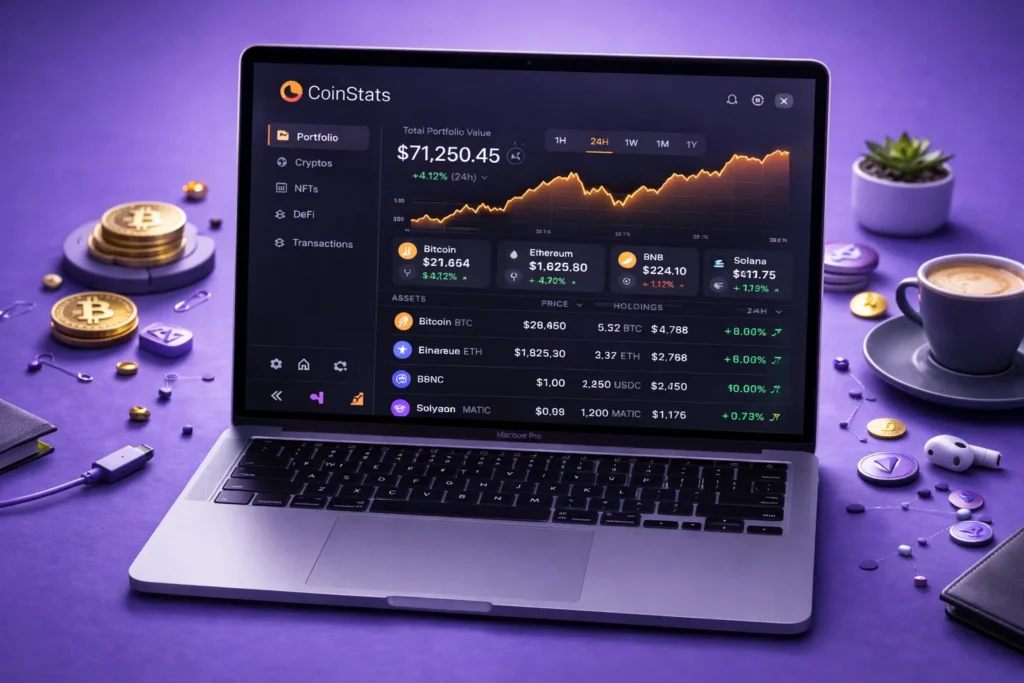
CoinStats is a crypto portfolio tracker and management platform that lets users monitor assets across exchanges, wallets, DeFi protocols, and NFT collections from a single dashboard. Unlike basic trackers, it combines real-time price data, P&L analysis, and AI-driven insights, making it useful for both casual holders and active traders managing complex, multi-chain portfolios.
See also our CoinStats vs CoinTracker review for a more in-depth analysis.
Is CoinStats Legit?
A credible crypto portfolio tracker must demonstrate longevity, transparency, security discipline, and consistent product development. Here’s a deeper analysis.
1. Years in Operation & Market Presence
CoinStats was launched in 2017. In crypto terms, that’s significant. Many crypto tracking apps shut down within 2–3 years due to:
- Security incidents;
- Lack of funding;
- Poor product-market fit;
- Regulatory pressure.
Operating for nearly a decade suggests operational stability and sustainable demand. The platform has survived multiple market cycles, including bull runs and severe downturns, which adds credibility.
2. Scale of Integrations & Ecosystem Coverage
A credible crypto portfolio tracker must command broad ecosystem integration.
CoinStats supports:
- 300+ exchanges and wallets;
- 20,000+ crypto assets;
- 1,000+ DeFi Protocols (Uniswap, Aave, and Compound);
- Major centralized exchanges (Binance, Coinbase, Kraken, KuCoin);
- Public address tracking for DeFi protocols;
This scale matters because it shows:
- Ongoing technical maintenance;
- Active API partnerships;
- Infrastructure capacity.
Fly-by-night platforms rarely support hundreds of integrations. Maintaining this level of connectivity requires engineering investment and consistent updates.
3. Public App Store Presence & Ratings
CoinStats is publicly available on both major mobile platforms. On Google Play, the CoinStats app has a 4.6 out of 5 rating based on 104,000+ reviews and 1M+ downloads. On the Apple App Store, it maintains an even higher 4.8 out of 5 rating from more than 82,000 users.
Additionally, on the Mac App Store, CoinStats has a 4.9 out of 5 rating based on 276 ratings, further reinforcing strong user satisfaction across devices.
These are not small sample sizes. High ratings across tens of thousands of reviews suggest consistent user satisfaction rather than isolated positive feedback. Also, listing on Google Play and the Apple App Store requires CoinStats to meet strict security, privacy, and operational standards. Failure to comply can result in removal from these platforms.
4. Transparency & Public Presence
An important legitimacy indicator for any crypto platform is its level of public visibility and communication. CoinStats operates an official website where users can find product details, update logs, and platform information.
The company also maintains active profiles on several major social and professional networks, including Telegram, X (Twitter), YouTube, Reddit, Instagram, TikTok, and LinkedIn.
Transparency also extends to product evolution. CoinStats regularly releases updates to its app, expands exchange and DeFi integrations, and introduces new features such as analytics tools and portfolio insights.
Continuous updates and visible development cycles are indicators of an actively maintained platform rather than a static or abandoned product.
5. Track Record & Security History
When assessing whether CoinStats is legit, users often look into its security history, including potential data breaches, fund losses, or API key compromises.
CoinStats primarily operates as a crypto portfolio tracker, not a centralized exchange that holds users’ deposits by default. It relies mainly on read-only API connections and public wallet tracking, which limits custodial risk since it does not require withdrawal permissions.
Yet, security also depends on user setup. Best practices include using read-only API keys, enabling 2FA, never sharing private keys, and regularly monitoring account activity. While no crypto platform is entirely risk-free, CoinStats’ architecture reduces exposure compared to fully custodial services.
Key Features of CoinStats

1. Advanced Crypto Portfolio Tracker
At its core, CoinStats is a comprehensive crypto portfolio tracker that consolidates your entire portfolio into a single intelligent dashboard. With CoinStats, you no longer need to track balances manually. The platform aggregates data from multiple sources and displays your total portfolio in real time.
Key capabilities include:
- Real-time prices for thousands of crypto assets;
- Detailed P&L (profit and loss) breakdown per asset and total portfolio;
- Advanced portfolio history tracking with performance charts;
- Full transaction history and trading history across exchanges;
- Allocation analysis based on market cap parameters and asset weight;
- Loss analysis tools to evaluate drawdowns and volatility.
With this structured portfolio tracking, you can monitor diversification, risk exposure, and capital efficiency without relying on spreadsheets. If you manage spot holdings, staking rewards, NFTs, and DeFi positions simultaneously, this unified crypto portfolio view significantly improves clarity and decision-making accuracy.
2. CoinStats Wallet
The CoinStats Wallet operates as a non-custodial solution, ensuring users retain control of their private keys and, therefore, their crypto assets. This structure directly addresses one of the primary risks in crypto: reliance on centralized custodians that are vulnerable to hacks or operational failures.
Core wallet features include:
- Multi-chain asset support;
- Secure storage for tokens and NFT holdings;
- Integrated swap feature for token exchanges;
- Direct access to DeFi investments and decentralized applications;
- Visibility into NFT collections within the same interface.
Unlike centralized exchanges, which hold your assets in their custody, the CoinStats wallet gives you full ownership. Proper key management ultimately determines security, but the architecture reduces platform-side custodial risk.
If you worry about data breaches, withdrawal freezes, or counterparty risk, you strongly benefit from the non-custodial structure.
3. CoinStats Multi-Exchange Integrations
A major differentiator for CoinStats is its breadth of integrations. The platform supports connections to over 300 exchanges and wallets. You can connect your crypto accounts through API keys, typically configured as read-only. CoinStats accesses balance data and transaction history without enabling trading or withdrawals.
Security benefits of this setup:
- No withdrawal permissions required;
- Reduced exposure if an API key is compromised;
- Encrypted data transmission;
- User-side control over API permissions.
You can track any wallet via its public address and monitor on-chain activity across other wallets, hardware wallets, and DeFi addresses. This infrastructure enables you to seamlessly track crypto across exchanges and wallets, which is particularly valuable for active traders operating on multiple platforms.
4. CoinStats Decentralized Finance Tools
Tracking DeFi positions is notoriously challenging. You often lock assets in liquidity pools, staking contracts, lending platforms, or yield farming strategies. CoinStats solves this by integrating with over 1,000 DeFi protocols.
Capabilities include:
- Real-time monitoring of staking rewards;
- Yield farming position visibility;
- Liquidity pool tracking;
- On-chain data aggregation;
- Portfolio allocation including DeFi assets.
By pulling on-chain data directly into the dashboard, CoinStats ensures your crypto holdings reflect all deployed capital, not just exchange balances. For DeFi-focused investors, this improves capital-efficiency analysis and helps evaluate the portfolio’s true performance, including passive income streams.
5. Market Insights, Alerts & AI Analytics
Beyond tracking, CoinStats incorporates intelligent market monitoring tools that support proactive decision-making.
Core features include:
- Real-time alerts for price movements;
- Fully customizable alerts and threshold triggers;
- Integrated auto alert system notify functionality;
- Market cap parameters filtering;
- Aggregated crypto news feed;
- Social sentiment tracking from the broader crypto community.
One standout feature is CoinStats AI. The system analyzes portfolio structure, volatility patterns, and asset correlations to generate actionable insights. For example, CoinStats AI analyzes concentration risk, performance variance, and allocation imbalance, helping users make smarter decisions based on data rather than emotion.
The platform also offers:
- Crypto widgets and a native widget for home-screen monitoring;
- Real-time performance updates;
- Asset-level performance analytics;
- Risk and loss analysis metrics;
This transforms CoinStats from a basic tracker into a strategic crypto research companion.
How CoinStats Works
Understanding core features is one step; knowing how the platform operates is another. Here’s how CoinStats works in practice:
Step 1: Connect Your Accounts
First, users link their exchange accounts or wallet addresses. For centralized exchanges, this is done using API credentials with predefined permissions. For on-chain wallets, users simply add a public address.
Once connected, CoinStats begins syncing data from those selected sources.
Step 2: Aggregate and Standardize Data
After integration, CoinStats collects balances, transaction records, token prices, and historical trades. The platform standardizes diverse data into a consistent structure. This enables accurate cross-platform portfolio calculations.
Step 3: Calculate Portfolio Metrics
Once the data is organized, CoinStats applies its calculation engine to generate performance metrics. These include:
- Net portfolio value;
- Historical growth trends;
- Asset allocation breakdown;
- Realized and unrealized P&L;
- Performance comparisons across custom timeframes.
Metrics update dynamically as market prices fluctuate or new transactions are detected.
Step 4: Maintain Continuous Synchronization
CoinStats periodically refreshes account data to reflect new trades, transfers, staking rewards, or DeFi activity. If a sync interruption occurs, users can manually trigger a refresh to ensure portfolio data remains aligned with the original exchange or wallet.
Step 5: Activate Alerts and Analytics
After portfolio tracking is established, users can configure monitoring tools. This includes setting alerts based on price levels, portfolio value changes, or asset movements. The analytics layer also evaluates allocation shifts and market behavior to provide structured performance insights.
Is CoinStats Safe?
Security is a decisive factor when choosing any crypto tracker, especially when a platform aggregates data from your entire crypto portfolio. While API permissions and wallet structure matter, there are additional security aspects worth examining.
Infrastructure & Data Handling Model
CoinStats functions as a data aggregation and analytics platform. It is not a trading venue and does not act as a liquidity provider. This distinction is important because CoinStats does not execute trades on your behalf or act as a clearing intermediary between exchanges.
Its systemic exposure is lower than that of broker-style platforms. The primary risk surface relates to data visibility, not direct asset control.
Permission Segmentation & Account Isolation
Each connected exchange or wallet operates independently. If an API key is revoked or disrupted on one exchange, it does not automatically impact other connected wallets or platforms. This separation limits cross-account exposure.
From a risk management perspective, this structure reduces the chance of cascading failures.
Manual Control & Revocation
Users maintain full control over API permissions at the exchange level. If suspicious activity is detected, API keys can be revoked directly from the source exchange. Once revoked, CoinStats loses access immediately.
This provides an external control layer that remains outside the app itself.
No Default Fund Custody
CoinStats does not, by default, pool or custody exchange-connected assets.
This reduces exposure to:
- Platform insolvency;
- Centralized liquidity failures;
- Custodial freezes.
Users concerned about exchange collapses or large-scale data breaches may find this structural separation reassuring.
Practical Risk Considerations
No crypto platform is entirely risk-free. Thus, users should consider:
- How many exchanges and wallets are connected;
- The total size of their portfolio exposure;
- Private key storage practices;
- Device and account security hygiene.
As a result, CoinStats reduces risk through a read-only, non-custodial model. Yet, overall safety still depends partly on user behavior.
CoinStats Pricing and Plans
CoinStats offers four tiers: Basic (Free), Premium, Degen, and Team. Below is a simplified comparison based on the current pricing page.
| Plan | Key Details |
|---|---|
| Basic (Free) | Price: Free; Portfolios: 10; Transactions: 20,000; Daily Sync: 40 per portfolio; Support: Basic (Under 72h); Includes: Portfolio heatmap, asset allocation analytics, profit & loss, and custom alerts. |
| Premium | Price: $8.33/month (billed yearly); Portfolios: 100; Transactions: 100,000; Daily Sync: 200 per portfolio; Support: Priority (Under 24h); Includes: Advanced portfolio performance analytics, wallet analyzer, fees-paid analyzer, coin insights, AI bull-market price, ad-free, and transaction notifications. |
| Degen | Price: $62.91/month (billed yearly); Portfolios: 500; Transactions: 1,000,000; Daily Sync: Unlimited; Support: VIP (Under 1h); Includes: Token risks, time machine, 0% swapping fees, all premium features. |
| Team | Price: Custom; Includes: All Premium features; Support: VIP via Dedicated Channel; Extras: Seats for communities, personalized features upon request. |
CoinStats User Experience & Customer Support
A crypto portfolio tracker is only as good as its daily usability. Beyond features and pricing, CoinStats’ long-term value depends on how smoothly it runs and how responsive its support team is.
App Usability
CoinStats offers a clean, modern dashboard that clearly displays portfolio value, allocation, P&L, and asset-level performance. Most users appreciate:
- Intuitive interface;
- Real-time price updates;
- Easy wallet and exchange connections;
- Clear portfolio breakdowns.
The mobile app is especially popular for quick monitoring and alerts, while the desktop version is better suited for deep analysis and exports. Some users note that setting up multiple wallets can take time, and advanced analytics may require a short learning curve.
Sync Speed & Common Issues
CoinStats relies on exchange APIs and public wallet tracking. Syncing is generally reliable, but user reviews on Trustpilot note occasional issues:
- API disconnects;
- Delayed balance updates;
- Manual refresh requirements.
Many of these issues are linked to exchange-side API limitations rather than the platform itself.
Customer Support
Support is available via help center articles and ticket/email support, which is described as real, quick, and effective. As previously mentioned, response times depend on the plan:
- Free: up to 72 hours;
- Premium: around 24 hours;
- Higher tiers: priority support.
In summary, while all users have access to support, those on paid plans typically experience faster responses, especially during busy periods.
Overall, CoinStats delivers a solid user experience for investors managing assets across multiple exchanges, wallets, DeFi protocols, and NFTs. While occasional sync or billing concerns appear in public reviews, the platform remains functional and practical for consolidated crypto portfolio tracking.
Pros & Cons of CoinStats
| Strengths | Limitations |
|---|---|
| Consolidates your entire crypto portfolio across exchanges, wallets, DeFi protocols, and NFT holdings into one dashboard; | Advanced portfolio performance analytics and tools are locked behind paid tiers; |
| Broad ecosystem coverage (300+ exchanges, 1,000+ DeFi protocols, 20,000+ crypto assets); | Setup can take time for multiple wallets; |
| Detailed P&L tracking with historical portfolio history and allocation breakdown; | Requires correct API setup and user-side security hygiene. |
| Read-only API architecture reduces custodial risk exposure; | Complex portfolios with multiple wallets may require manual adjustments. |
| Custom alerts, real-time prices, and portfolio-level notifications; | |
| Exportable transaction history for reporting and tax preparation. |
Who Should Use CoinStats?
CoinStats is designed to accommodate different types of crypto investors, but its true value becomes clearer when viewed through the lens of specific portfolio needs and management styles.
Below are the profiles that may benefit most from using the platform:
- Active traders: Need consolidated trading history, rapid P&L snapshots, and per-exchange breakdowns to evaluate strategy performance.
- DeFi investors: Benefit from on-chain position aggregation, staking/reward visibility, and liquidity pool tracking to measure deployed capital.
- NFT collectors: Use unified views showing NFT collections and floor-value exposure alongside fungible holdings.
- Long-term HODLers: Gain value from historical performance charts, allocation tracking, and loss-analysis tools to evaluate rebalancing needs.
- Crypto tax planners & accountants: Rely on line-item exports and cost-basis reports to prepare filings across multiple exchanges and wallets.
FAQ
No. CoinStats aggregates and displays holdings; withdrawals must be initiated from the exchange or wallet that holds the assets.
CoinStats provides exportable reports you can use for tax filings, but it does not directly report user accounts to tax authorities.
Steps: (1) Check sync timestamp; (2) manually resync the affected account; (3) verify on-chain via a block explorer or exchange transaction history; (4) file a support ticket with the export of the missing TX if it remains unresolved.
You can’t cash out from CoinStats because it doesn’t hold your funds. To withdraw to Cash App, sell your crypto on the exchange or wallet where it’s stored, then transfer the money to your bank or Cash App.
Final Verdict: Is CoinStats Worth It?
CoinStats is a capable crypto portfolio tracker for users who need a single view of an entire crypto portfolio across exchanges, wallets, DeFi positions, and NFTs. Its strengths are dashboard flexibility, exportable data for tax and analysis, and scalable plans that suit both casual holders and high-volume traders.
If you manage multiple wallets, need reliable portfolio history, and want advanced alerts and analytics, the Premium or higher tiers are worth the cost. For basic tracking of a few assets, the free tier is useful.
Overall, in this CoinStats review, the platform stands out for practical portfolio management and research workflows, especially for users who value consolidated data, actionable insights, and exportable records for tax/accounting.